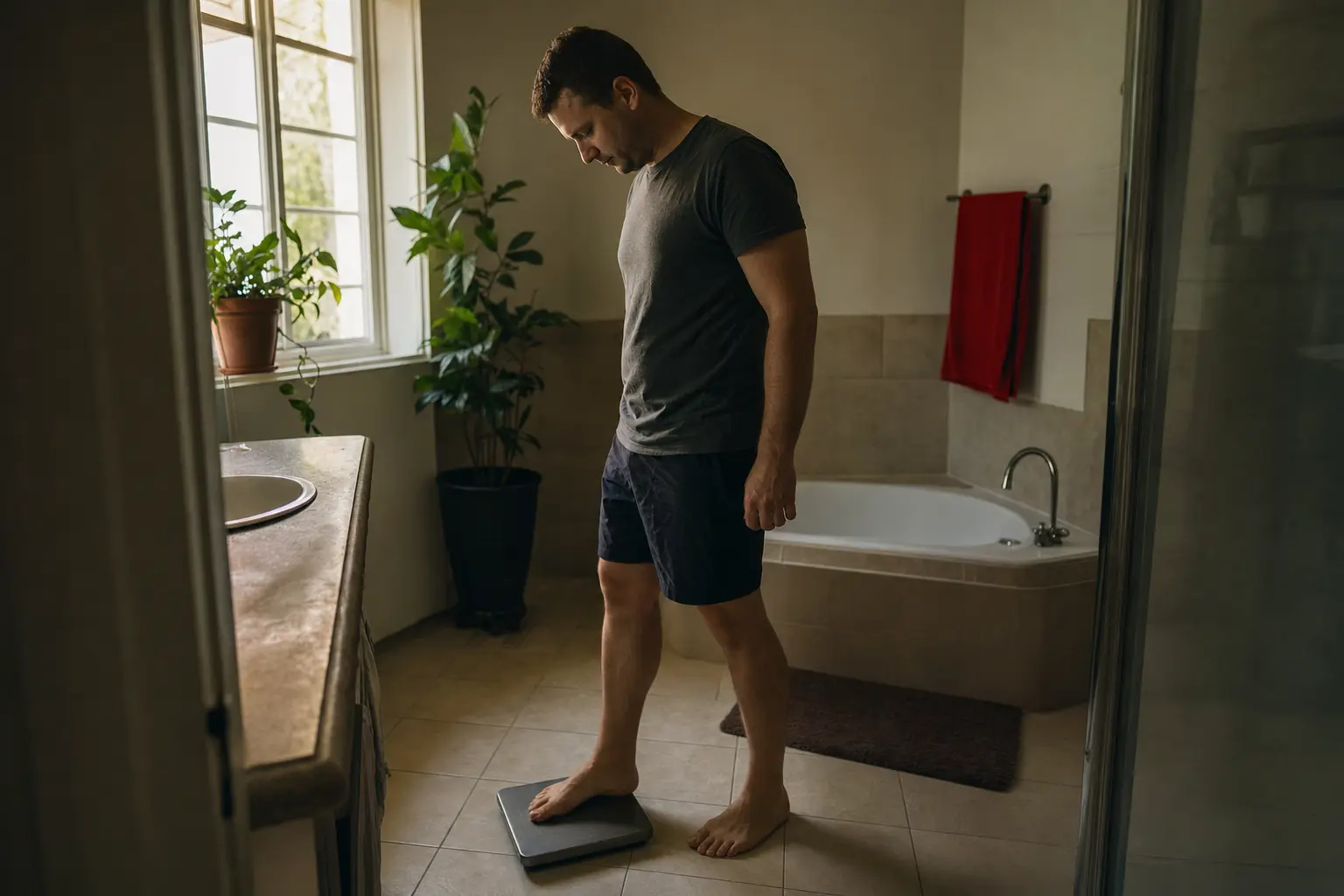
 AI-generated image
Guides · Food and nutrition · Updated 2026-11-11
When is the best time to weigh yourself?
The best time to weigh yourself is first thing in the morning, after you use the bathroom and before you eat or drink anything. Wear the same thing each time, or nothing, and use the same scale on a hard, flat floor. Your weight can swing a pound or two from one day to the next, so compare weekly averages instead of single readings.
- Weigh in after you wake up. Use the bathroom first, then step on the scale before you eat or drink.
- Keep everything the same. Use the same scale in the same spot on a hard floor, and wear the same clothes or none.
- Write it down. Log the number right away, even when it's higher than you hoped.
- Average the week. Add up the week's readings and divide by how many you took. Compare this week's average with last week's.
Why the morning works best
By morning, you’ve had nothing to eat or drink for hours. You can also use the bathroom first. That makes each morning reading as close as possible to the one before. Later in the day, your weight includes whatever you’ve eaten and drunk, which changes from day to day.
The time matters less than doing it the same way. Use the same scale on the same floor, in the same clothes.
Read the trend, not the day
Your weight can move a pound or two overnight from water and salt alone. One reading can’t tell you if you gained fat. An average over a week smooths that out.
Here’s an example week:
| Day | Reading (lb) |
|---|---|
| Monday | 181.4 |
| Tuesday | 180.6 |
| Wednesday | 180.2 |
| Thursday | 180.8 |
| Friday | 179.8 |
| Saturday | 179.6 |
| Sunday | 180.4 |
| Weekly average | 180.4 |
Tuesday looks like a loss and Thursday looks like a gain, but neither means much on its own. Compare this week’s average with next week’s.
Why weighing in helps
Keeping track of your weight is one of the habits most linked with weight loss in research on self-monitoring. In one study, people who weighed daily took up more healthy habits than those who weighed most days. The number is information, not a grade.
If you’re losing weight, see how much weight you can lose in a month for a realistic pace, and the weight loss plateau guide if the average stops moving. If you’re building muscle while losing fat, the scale may barely move at all: see body recomposition.
When to step back
If weighing yourself makes you anxious, or you have a history of an eating disorder, it’s fine to weigh less often or not at all. Talk to a doctor or registered dietitian about other ways to track your health.
Also asked
How often should you weigh yourself?
There's no single right answer. Some people weigh in every morning and others once a week. In one 6-month weight loss study, people who weighed every day lost more weight than those who weighed most days. If daily weigh-ins upset you, once or twice a week is fine.
Should you weigh yourself every day?
You can, as long as you read the weekly average and not each number. Daily readings give you a better average. If the number starts to control your mood or your eating, weigh less often and talk to a doctor.
Why do I weigh more on Mondays?
Weekends tend to bring a little gain that comes off during the week. A large European study found a typical weekly swing of about 0.35 percent, higher after the weekend and lower through the week. That's about half a pound for a 150 lb person.
Is it better to weigh yourself at night?
Night weigh-ins include the day's food and drink, so they read higher and vary more. Morning is easier to keep the same from day to day. If you can only weigh at night, keep it to the same time.
Should I weigh myself after a workout?
It's better not to. A hard session can leave you lighter from sweat, and you'll gain it back when you drink. Weigh in the morning instead.
How much can my weight change in a day?
A pound or two from day to day is normal, and many people move within a range of about 5 pounds. Salt, carbs, water and a hard workout can all shift it.
App names belong to their owners. TrainRec isn't affiliated with or endorsed by them. Prices and features were checked on the date at the top of this page, and can change.
Sources
- Cleveland Clinic (2023), The best time to weigh yourself (and how often you should step on the scale)
- Steinberg et al. (2015), Weighing every day matters: daily weighing improves weight loss and adoption of weight control behaviors
- Turicchi et al. (2020), Weekly, seasonal and holiday body weight fluctuation patterns among individuals engaged in a European multi-centre behavioural weight loss maintenance intervention
- Burke et al. (2011), Self-monitoring in weight loss, a systematic review of the literature