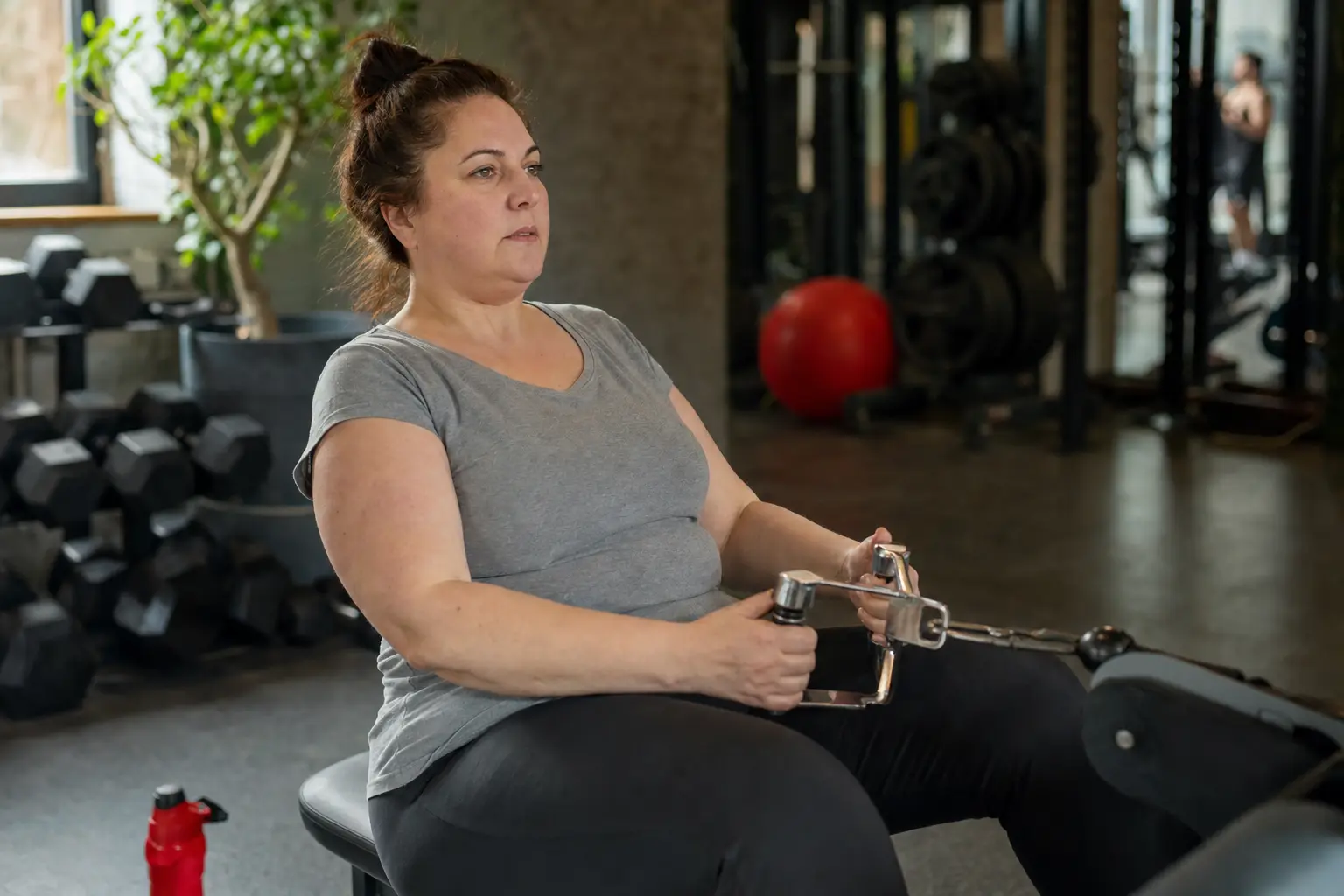
 AI-generated image
Guides · Strength training · Updated 2026-11-20
Do GLP-1 medicines cause muscle loss, and how do I keep my muscle?
Some of the weight lost on semaglutide or tirzepatide is lean mass, not fat. Studies put it at about a quarter of the total. In one tirzepatide trial, the share was the same for people on placebo. Strength training and enough protein are the two things shown to protect muscle. A 2025 advisory from four nutrition and obesity societies recommends strength training at least 3 times a week.
- Lift at least three times a week. Train your whole body with weights or machines. Start light and add a little over time.
- Eat enough protein. Aim for the target your care team sets. A common simple target is 80 to 120 grams a day.
- Don't let calories fall too low. Eat small meals on a schedule even when you are not hungry.
- Track your strength. Write down your lifts. If the weights hold steady or go up while the scale drops, you are likely keeping muscle.
What the studies found
Any large weight loss takes some lean mass with the fat. Lean mass is everything that is not fat, so it counts muscle along with other tissue. A 2025 advisory from four medical societies notes that muscle is about half of it.
| Study | What was measured | Result |
|---|---|---|
| Semaglutide trial, body scan group (reported in the 2025 advisory) | Average 13.6 kg lost | 8.3 kg fat, 5.3 kg lean mass |
| Tirzepatide trial, 160 people with body scans | Share of weight lost | About 75 percent fat, 25 percent lean mass |
| Review of 22 trials, 2,258 people | Share of weight lost | Lean mass about 25 percent |
| Modeling cited by the advisory | Muscle as a share of weight lost, with no strength training | 10 to 15 percent in women, 20 to 25 percent in men |
Two details help put this in context:
- In the tirzepatide trial, the split was the same for people on placebo. About 75 percent of what they lost was fat too. The medicine group simply lost much more weight in total.
- The 22-trial review found that the medicines with the largest weight loss, semaglutide and tirzepatide, were also among the weakest at holding on to lean mass.
So the share of lean mass lost looks much like other weight loss. The amount is bigger because the weight loss is bigger. That is worth acting on.
Semaglutide is sold under brand names such as Ozempic and Wegovy. Tirzepatide is sold as Mounjaro and Zepbound. Liraglutide is sold as Saxenda and Victoza. This page uses the generic names, as the studies do. Brand names differ by country.
What protects muscle
Strength training
This has the strongest evidence. A review of six trials in older adults with obesity compared dieting alone with dieting plus lifting three times a week for 12 to 24 weeks. Lifting prevented 93.5 percent of the lean mass loss. Fat loss was about the same in both groups.
The 2025 advisory says GLP-1 medicines should come with a structured exercise program. Its target is strength training at least 3 times a week, plus at least 150 minutes of moderate aerobic activity, matched to the person’s fitness.
A week that meets it is laid out in the GLP-1 workout plan. If you are new to lifting, start with a full-body workout for beginners.
Protein
The advisory makes protein a priority for keeping muscle and bone, together with strength training. It offers 80 to 120 grams a day as a simple target. See how much protein to eat on a GLP-1 medicine.
Enough food overall
People on these medicines eat 16 to 39 percent fewer calories. Very low intake makes it harder to keep muscle and to get enough vitamins and minerals. Small meals on a schedule help. See the GLP-1 diet plan.
How to tell if you are keeping muscle
A bathroom scale cannot tell fat from muscle. These can help:
- Your lifts. If the weights you lift hold steady or rise while your body weight drops, that is a good sign.
- Daily tasks. Stairs and carrying bags should get easier, not harder.
- Waist measurement. A shrinking waist points to fat loss.
- A body scan. Ask your prescriber if one makes sense for you.
Adding weight or reps slowly over time is called progressive overload, and it is the signal that tells your body to keep its muscle.
Who should take extra care
Losing muscle matters more for older adults and for anyone who starts with little of it. If that is you, ask your prescriber about seeing a registered dietitian and a qualified trainer or physical therapist before you start. Strength training over 50 covers a gentle way in.
Tell your prescriber if you feel weaker or more tired than you expect. Never change your dose on your own. This page is general information, not medical advice.
Ozempic, Wegovy, Saxenda and Victoza are trademarks of Novo Nordisk A/S. Mounjaro and Zepbound are trademarks of Eli Lilly and Company. They are named only to say which medicines this page is about. Neither company is connected to this site or endorses it.
Also asked
How much of the weight lost is muscle?
Studies measure lean mass, which is muscle plus other tissue that is not fat. In a tirzepatide trial and in a review of 22 trials, lean mass was about 25 percent of the weight lost. Muscle is about half of lean mass.
Is muscle loss worse on GLP-1 medicines than on a diet?
The share looks similar. In the tirzepatide trial, about 75 percent of the weight lost was fat in both the medicine group and the placebo group. The total lost is larger on the medicine, so the amount of lean mass lost is larger too.
Can I build muscle while on a GLP-1 medicine?
Strength training can add muscle and strength in most adults. One review found supervised programs longer than 10 weeks can add about 3 kg of lean mass and about 25 percent in strength. How much you gain while eating less will vary.
Does it matter if I lose some lean mass?
Some loss is expected when a body gets smaller. It matters more for older adults, since less muscle can mean less strength and balance. That is why the advisory pairs these medicines with strength training.
Do Ozempic, Wegovy, Mounjaro and Zepbound cause muscle loss?
Ozempic and Wegovy are brand names for semaglutide, and Mounjaro and Zepbound are brand names for tirzepatide. Trials of both medicines found that part of the weight lost was lean mass, which includes muscle. Strength training and enough protein are the two things shown to protect it.
Sources
- Mozaffarian et al. (2025), Nutritional priorities to support GLP-1 therapy for obesity: a joint Advisory from the American College of Lifestyle Medicine, the American Society for Nutrition, the Obesity Medicine Association, and The Obesity Society
- Look et al. (2025), Body composition changes during weight reduction with tirzepatide in the SURMOUNT-1 study of adults with obesity or overweight
- Karakasis et al. (2025), Effect of glucagon-like peptide-1 receptor agonists and co-agonists on body composition: Systematic review and network meta-analysis
- Locatelli et al. (2024), Incretin-Based Weight Loss Pharmacotherapy: Can Resistance Exercise Optimize Changes in Body Composition?
- Sardeli et al. (2018), Resistance Training Prevents Muscle Loss Induced by Caloric Restriction in Obese Elderly Individuals: A Systematic Review and Meta-Analysis
- Cava et al. (2017), Preserving Healthy Muscle during Weight Loss