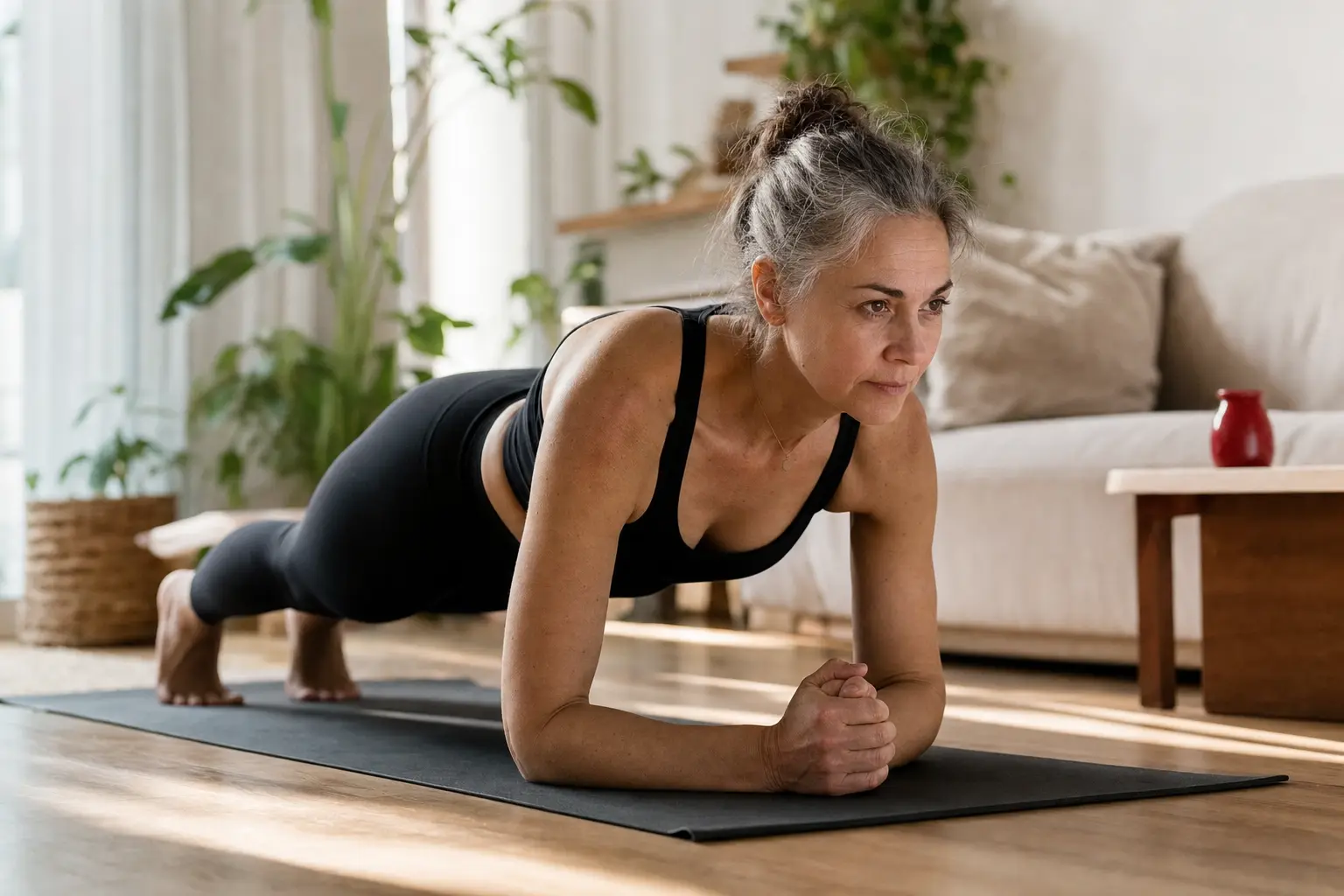
 AI-generated image
Guides · Strength training · Updated 2026-11-01
How long should I hold a plank?
Most people get more from a few holds of 10 to 60 seconds with good form than from one long hold. Harvard Health suggests about 60 seconds of plank time in total, split into as many holds as you need, and building toward one full minute. Past one or two minutes there is little extra benefit. Once a minute feels easy, make the plank harder, for example with a weight plate on your upper back, instead of holding longer.
- Set your elbows. Lie face down. Put your forearms on the floor with your elbows right under your shoulders.
- Lift into a straight line. Push through your forearms and toes so your body makes a straight line from your head to your heels. Don't let your hips sag or rise.
- Brace and breathe. Tighten your stomach and squeeze your glutes. Look at the floor and take slow, even breaths.
- Stop when your form slips. End the hold as soon as your hips drop or your lower back starts to ache. Rest, then do another hold until you reach about 60 seconds in total.
The short answer
Aim for a few holds of 10 to 60 seconds with good form, not one long hold. Harvard Health suggests a simple target: about 60 seconds of plank time in total, split into as many holds as you need. If your best hold is 15 seconds, do four of them, with 30 to 60 seconds of rest in between.
Over time, work toward holding a full minute in one go. Once a minute feels easy, holding longer doesn’t add much. Harvard Health notes that 2 minutes is often treated as the upper limit, with little gain past it. That’s the point to make the plank harder instead.
How long you can hold it isn’t the goal
A plank trains your core to keep your body still while something tries to bend it. That only happens while your form is good. Once your hips sag, your lower back takes over and the hold stops doing its job.
That’s why short holds tend to work better. In a small 2015 study, six weeks of core training built around holds made the trunk stiffer than training with moving exercises did. Stiffer here is a good thing: it means your trunk can brace well when you lift or carry.
What’s a good plank time?
There’s no single standard, but one study gives a rough idea. Researchers timed 471 college students in a forearm plank, holding as long as they could with good form:
| Group | Average hold |
|---|---|
| Men | About 2 minutes (124 seconds) |
| Women | About 1 minute 20 seconds (83 seconds) |
The spread was wide, and these were young adults, many of them athletes. Don’t worry if you’re far from these numbers. Compare yourself with your own last week, not with a table.
How to build up your plank
Harvard Health’s way to start is to add a little at a time. If you can hold for 3 seconds, try 4. Once you can hold 4, work up to 10. Then:
- Add holds first. Do enough short holds to reach about 60 seconds in total.
- Then stretch each hold. Add a few seconds to each hold as it gets easy.
- Rest 30 to 60 seconds between holds.
- Repeat a few times a week. Daily is fine if you feel fresh.
If a full plank is too hard, rest on your knees instead of your toes. Or lean on a kitchen counter so your body sits at an angle. Both train the same muscles with less load. Our push-up guide uses the same straight-line position, so planks and push-ups help each other.
Weighted planks
A weighted plank is a normal plank with a weight plate resting on your upper back. It’s the easiest way to keep progressing once a minute feels easy, because you add load instead of time. This is the same idea as progressive overload on any other exercise.
When you’re ready
Wait until you can hold a clean 60 second plank with no sag. If your hips drop near the end of an unweighted plank, weight will only make that worse.
How to load it safely
- Use a partner. Get into your plank and brace first. Then have a partner set the plate flat on your upper back, between your shoulder blades, and lift it off at the end. Reaching back to place a plate yourself twists your spine.
- Start light. Use the lightest plate you have, and add more only when you can hold 30 seconds with good form.
- Keep holds short. About 10 to 30 seconds per hold is plenty with weight. Do a few holds rather than one long one.
- Get out with care. At the end, lower your knees to the floor first, then have your partner take the plate.
Never put the plate on your lower back. It pushes your hips down into the exact sag you’re trying to avoid. Skip weighted planks while you have lower back pain.
No plate or no partner?
A weight vest does the same job without anyone’s help. You can also make a plank harder with no weight at all:
- Lift one leg for a second or two, then switch. Harvard Health suggests this as a next step.
- Walk your elbows forward a few inches. The longer your body, the harder it gets.
Where planks fit in a workout
Planks are a good finisher after strength work or a short add-on at home. Our full-body workout for beginners uses 2 sets of 20 to 40 seconds at the end. Put them after your main lifts, not before, so your core is fresh when you squat or deadlift.
If you’re older or coming back from a break, start with the knee or counter version. Our guide to strength training over 50 covers how to ease in.
Also asked
How long should a beginner hold a plank?
Whatever you can hold with good form, even if that's only a few seconds. Harvard Health's advice is simple: if you can hold for 3 seconds, try 4, then work up to 10. Do several short holds that add up to about 60 seconds, and add a few seconds each week.
Is a 2 minute plank good?
Yes, it shows good core endurance. In a study of 471 college students, men held a forearm plank for about 2 minutes on average and women for about 1 minute 20 seconds. Harvard Health notes that 2 minutes is often treated as the most worth doing, so past that point, make the plank harder rather than longer.
Is it better to do one long plank or several short ones?
Several short ones, for most people. Harvard Health suggests multiple holds of up to about 30 seconds with rest in between. Short holds make it easier to keep good form the whole time, and form is what trains your core.
How do you do a weighted plank safely?
First make sure you can hold a clean plank for a full minute. Then have a partner set a light plate flat on your upper back once you're in position, and lift it off when you're done. Keep weighted holds short, about 10 to 30 seconds. Stop the moment your hips sag.
How often should I do planks?
Every day is fine, and so is two or three days a week as part of your normal workouts. Harvard Health says either works. If your back or shoulders feel sore the next day, take a day off.
What if planks hurt my back?
Stop and try an easier version: rest on your knees, or lean on a kitchen counter so your body is at an angle. Lower back pain during a plank often means your hips have sagged. If the pain stays, or you already have back pain, check with your doctor before you keep going.
Sources
- Harvard Health Publishing (2021), Try this move for better core strength
- Harvard Health Publishing (2019), Straight talk on planking
- Strand et al. (2014), Norms for an isometric muscle endurance test (Journal of Human Kinetics)
- Lee and McGill (2015), Effect of long-term isometric training on core/torso stiffness (Journal of Strength and Conditioning Research), PubMed