 AI-generated image
Guides · Strength training · Updated 2026-10-26
How much weight should I lift as a beginner?
Start with a weight you can lift for 10 clean reps with 2 or 3 more left in the tank. For most beginners that means an empty barbell, or light dumbbells, on the big lifts. Once you can do all your sets at the top of your rep range with good form, add the smallest step you can: about 5 lb (2.5 kg) for upper body and 5 to 10 lb (2.5 to 5 kg) for legs.
- Learn the move with no weight or very little. Do 10 reps with your body weight, a broomstick or an empty bar until each rep looks the same.
- Do a test set. Pick a light weight and do 10 reps. Stop and ask how many more you could have done with good form.
- Adjust once. If you had more than 4 reps left, go up a step. If your form broke down, go down a step. Aim for 2 or 3 left.
- Train with it, then add a little. When you hit the top of your rep range on every set two sessions in a row, add the smallest jump your gym has.
The rule: 10 reps, with 2 or 3 left
You don’t need a chart to find your starting weight. You need one honest test set.
Pick a weight that looks easy and do 10 reps. At the end, ask yourself how many more you could have done with the same form. That number is your reps in reserve. Researchers use it to measure effort, and it works well for beginners too.
- More than 4 left: too light. Go up one step.
- 2 or 3 left: right where you want to be. Use this weight.
- 0 or 1 left, or your form changed: too heavy. Go down one step.
- You couldn’t finish 10: go down two steps, or switch to an easier version of the move.
Expect your first few sessions to feel easy. That’s the point. You’re learning the move while your muscles and joints get used to the work.
Starting points, exercise by exercise
These are first steps, not targets. Use the test set to fine-tune.
| Exercise | Start with | Then |
|---|---|---|
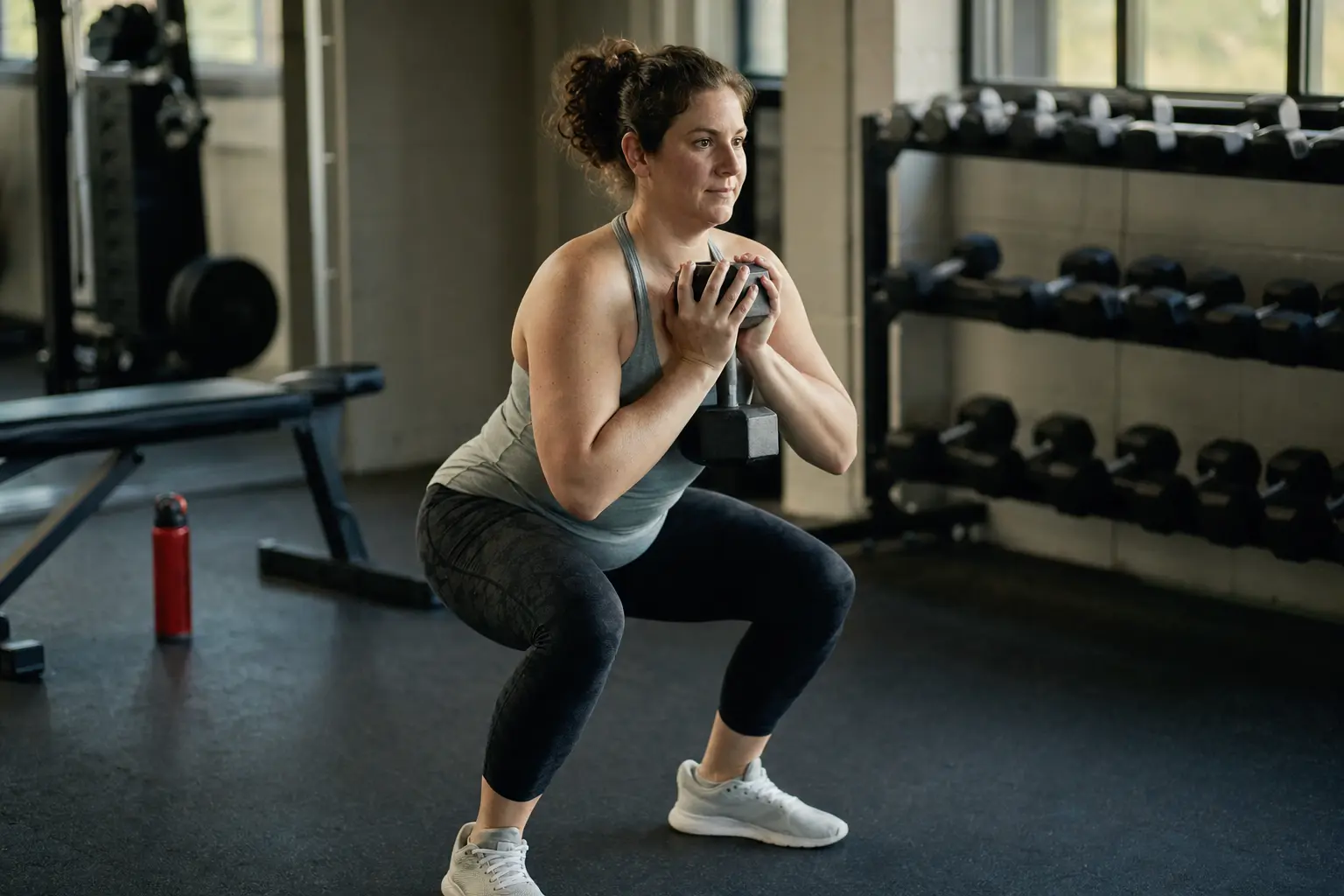
| Squat | Body weight squats to a box or bench | A light dumbbell held at your chest (goblet squat), then an empty bar |
| Bench press | An empty bar or a pair of light dumbbells | Small jumps of 5 lb (2.5 kg) |
| Deadlift | A light kettlebell or dumbbell from a raised spot | An empty bar with light plates, lifted from the right height |
| Overhead press | Light dumbbells | An empty bar once your shoulders move freely overhead |
| Rows | Light dumbbells, or a cable or machine at a low setting | Add weight when your back stays flat for every rep |
| Curls and other arm moves | The lightest dumbbells that feel like work | Small jumps, since arms gain more slowly |
| Machines | The lightest setting | Go up one pin at a time |
| Push-ups and pull-ups | An easier version, like push-ups on a bench or assisted pull-ups | Lower the bench or the help as you get stronger |
A standard barbell weighs about 45 lb (20 kg). Many gyms also have lighter bars of about 33 lb (15 kg). Some have fixed bars that start lower. Any of them is a fine place to start.
When to add weight
Pick a rep range, such as 8 to 12. Once you can do every set at the top of the range with good form, two sessions in a row, add the smallest jump your gym allows. That’s about 5 lb (2.5 kg) for upper body moves and 5 to 10 lb (2.5 to 5 kg) for squats and deadlifts. Then work back up to the top of the range. This is progressive overload, and it’s how strength builds.
In your first months, you may add weight every week or two. Later it slows down. That’s normal, not a sign you’re doing something wrong.
“How much should I be able to lift?”
Lists of average lifts are mostly built from people who already train, so they’re a poor guide for your first day. Your age and size change the number, and so does how long you’ve trained. A better question is whether you’re lifting more than you were a month ago, with the same clean form. If you are, it’s working.
If you want a number to track, our one-rep max calculator estimates your top single from a set of 5 to 10, without testing a heavy lift.
To turn your test set into a weight, the RPE calculator takes the weight, your reps and the reps you had left, and gives your weight for sets of 10.
Signs to drop the weight
- Your back rounds, or your hips rise before your chest does.
- You can’t control the weight on the way down.
- You feel sharp pain, not just effort. Stop, and check with a doctor or physical therapist if it lasts.
- You need to bounce or swing to finish a rep.
Lighter weight with good form builds strength faster than heavy weight you can’t control, because you can keep training week after week.
Also asked
How much should a beginner bench or squat?
There's no number you should hit on day one. Most beginners start the bench and squat with an empty bar or less, and the deadlift a little heavier. What matters is that the weight goes up over the first months.
Is it OK to start with just the bar?
Yes. A standard barbell weighs about 45 lb (20 kg), which is plenty to learn on. If it's too heavy, use dumbbells or a lighter bar first.
How do I know if a weight is too heavy?
Your form changes partway through the set, or you can't control the weight on the way down. Drop the weight and build back up.
How fast should the weight go up?
In your first months, small jumps every week or two are normal. Progress slows down later. That's expected.
Should I lift to failure as a beginner?
Not on most sets. Stopping 1 to 3 reps short of failure builds strength well and keeps form clean while you learn.