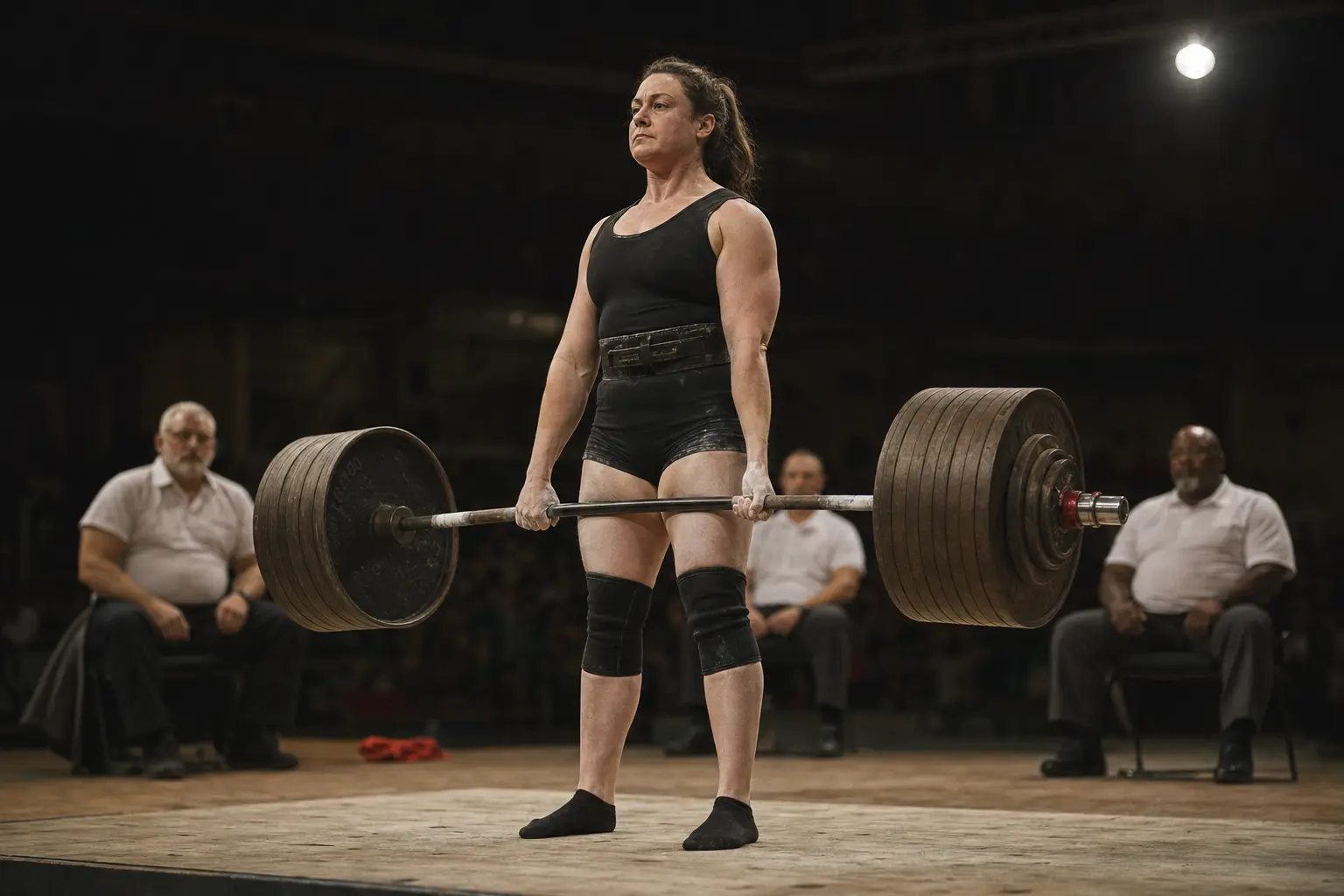
 AI-generated image
Free tools · Updated 2026-11-09
DOTS calculator
Enter your bodyweight and your powerlifting total to get your DOTS score, plus your Wilks and IPF GL points. Each one turns a total into a single number so lifters of different bodyweights can be compared. A 90 kg man with a 600 kg total scores about 388 DOTS and 80 IPF GL points.
387.96 DOTS
| Wilks | 383.04 |
| IPF GL points | 79.77 |
Your three best lifts added together.
How it works
Heavier lifters lift more in total, but not in proportion to their weight. Each formula fits a curve to that and gives you a multiplier for your bodyweight. Your total times the multiplier is your score. All three work in kilograms, so pounds are converted first.
DOTS: your total times 500, divided by a fourth-degree curve of your bodyweight. Bodyweights outside 40 to 210 kg for men, or 40 to 150 kg for women, are treated as the nearest end of that range. DOTS was made by Tim Konertz for the German federation (BVDK).
Wilks: your total times 500, divided by a fifth-degree curve of your bodyweight. This page uses the original Wilks coefficients. The IPF no longer uses Wilks, but many lifters still quote it.
IPF GL: your result times 100, divided by A minus B times e to the power of (minus C times your bodyweight). The IPF publishes A, B and C for each category:
| Category | A | B | C |
|---|---|---|---|
| Men, classic powerlifting | 1199.72839 | 1025.18162 | 0.00921 |
| Men, equipped powerlifting | 1236.25115 | 1449.21864 | 0.01644 |
| Men, classic bench press | 320.98041 | 281.40258 | 0.01008 |
| Men, equipped bench press | 381.22073 | 733.79378 | 0.02398 |
| Women, classic powerlifting | 610.32796 | 1045.59282 | 0.03048 |
| Women, equipped powerlifting | 758.63878 | 949.31382 | 0.02435 |
| Women, classic bench press | 142.40398 | 442.52671 | 0.04724 |
| Women, equipped bench press | 221.82209 | 357.00377 | 0.02937 |
The IPF's own worked example: a man in equipped powerlifting at 92.04 kg with a 1,035 kg total scores 112.855 IPF GL points. This calculator gives the same.
Which score should you use?
Use the one your federation or meet uses. IPF meets rank best lifters by IPF GL. Other federations may use DOTS or Wilks, so check your meet's rules. To compare yourself with yourself, any of them works, as long as you stick with one.
Every score starts with a real total, so the real work is getting stronger at the three lifts. Our guides to the squat, the bench press, the deadlift and warming up cover the basics, and the one-rep max calculator estimates a total from your training sets. For how your lifts compare with others your size, see strength standards.
Also asked
What is the difference between DOTS and Wilks?
Both turn a total and a bodyweight into one score, using a curve fitted to lifters of every size. Wilks is the older of the two. DOTS was made for the German powerlifting federation. In the example above, the two land within about 5 points of each other.
What does an IPF GL score of 100 mean?
The IPF sets 100 points as the average level of elite lifters at your bodyweight, in your event. So a score of 80 means your total is about 80 percent of that elite reference.
Can DOTS compare men and women?
DOTS was built for German team meets where men and women lift on the same team, so it puts both on one scale. IPF GL works the other way: it has separate numbers for each sex and event, and compares lifters within the same group.
Does DOTS adjust for age?
No. All three use only your bodyweight and your result, with separate numbers by sex. IPF GL also splits by event and equipment. Masters and junior lifters are usually compared within their own age group instead.
Can I score just my bench press?
Yes. IPF GL has its own numbers for bench-only meets, so pick bench press as the event. DOTS and Wilks were made for the three-lift total, so a bench-only score from them is only good for comparing bench with bench.
Sources
- International Powerlifting Federation (2020), The IPF GL coefficients for relative scoring (PDF)
- OpenPowerlifting, Dots points definition and coefficients (source code)
- OpenPowerlifting, Wilks coefficients and test values (source code)
- OpenPowerlifting, IPF GL coefficients and the IPF worked examples as tests (source code)