 AI-generated image
Guides · Strength training · Updated 2026-11-12
How do you do a Bulgarian split squat?
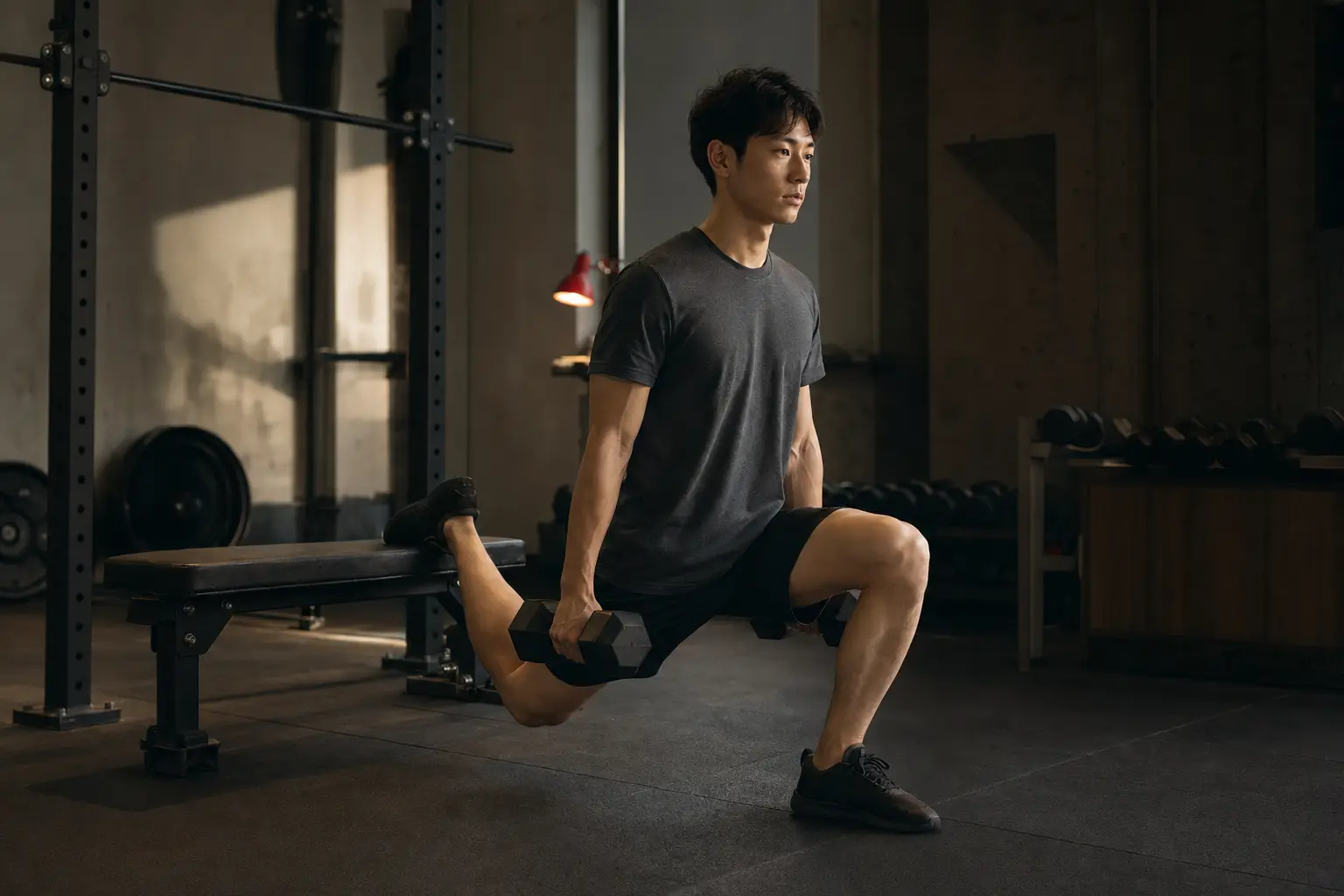
To do a Bulgarian split squat, stand a long step in front of a bench and rest the top of your back foot on it. Lower straight down until your front thigh is about level with the floor, then push through your front foot to stand. Keep most of your weight on the front leg and use the back leg only for balance. Start with no weight, then hold a dumbbell in each hand.
- Find your distance. Sit on the edge of a bench that is about knee height and stretch one leg out straight. The spot where your heel lands is a good place for your front foot.
- Set your back foot. Stand up on that spot and reach your other foot back onto the bench. Rest the top of that foot on the bench, laces down.
- Lower straight down. Bend your front knee and let your back knee drop toward the floor. Keep your front heel down and your front knee in line with your toes.
- Find your depth. Stop when your front thigh is about level with the floor, or just before your back knee touches down.
- Stand up. Push the floor away through your whole front foot. Finish all your reps on one leg, then switch.
What a Bulgarian split squat is
A Bulgarian split squat is a squat on one leg, with the top of your back foot resting on a bench behind you. Studies often call it the rear-foot-elevated split squat. Your front leg does the lifting. Your back leg is there to keep you steady.
It trains each leg on its own, so a little weight goes a long way. That makes it a good fit for a dumbbell leg workout at home. If you’re new to squatting, learn the two-leg version first in how to squat.
How far to stand from the bench
Sit on the edge of the bench and stretch one leg straight out. Stand up where your heel lands, and put your other foot back on the bench. That is a starting point, not a rule. Move your front foot a few inches at a time until the bottom of the squat feels steady.
| Sign | What it means |
|---|---|
| Your front heel lifts at the bottom | You’re too close. Step further from the bench |
| Your back hip or thigh feels pulled hard | You’re too far away, or the bench is too high |
| Your front shin is close to upright at the bottom | About right for most people |
| You tip sideways | Set your feet hip-width apart, as if on train tracks, not on a tightrope |
A 2023 study looked at step length in the regular split squat, with both feet on the floor. In 20 men, a longer step raised the activity of the glutes and hamstrings and did little to change the front thigh muscles. The authors suggested a step about as long as your leg.
Bulgarian split squat form: a quick check
| Body part | What to aim for |
|---|---|
| Front foot | Flat on the floor, with your weight over the middle of your foot |
| Front knee | In line with your toes. It can move forward a little |
| Back foot | Top of the foot resting on the bench, relaxed |
| Upper body | Chest up or leaning forward slightly, with a flat back |
| Depth | Front thigh about level with the floor, back knee just off it |
What muscles does the Bulgarian split squat work?
| Muscle | What it does |
|---|---|
| Front of the thigh (quads) | Straightens your front knee as you stand |
| Glutes | Push your hips up and forward out of the bottom |
| Hamstrings and inner thigh | Help your glutes at the hip |
| Side of the hip and core | Keep your hips level and your body upright |
A 2021 study compared it with the back squat in 20 trained men. In both lifts the hip did more of the work than the knee or the ankle. The knee also bent less in the Bulgarian split squat than in the back squat.
How much does the back leg help? Not much. In a study of 26 trained men, the front foot produced about 84% of the upward force across 715 reps.
Bulgarian split squats for glutes
Your glutes work hardest at the bottom of this lift. A 2021 study of 20 trained women compared it with the hip thrust. Glute activity was highest at the bottom of the split squat and at the top of the hip thrust. The authors suggested doing both, so see how to do a hip thrust.
In a 2023 study of eight college rugby players, the load on the hip muscles of the front leg was about 44% higher at the bottom than it was for each leg in a back squat. Each lift used a weight the players could lift 10 times.
Two small changes shift more of the work to your hips:
- Lean forward a little. In a 2025 study of 21 trained female athletes, leaning the upper body forward raised glute and hamstring activity. Keep your back flat.
- Take a slightly longer step. In the step length study above, a longer step raised glute activity.
No lift can pick where your body changes shape. Training makes the muscle stronger and bigger over time, and the rest comes down to your build. For the full picture, see how to grow your glutes.
Dumbbell and Smith machine Bulgarian split squats
| Version | How to hold the weight | Good to know |
|---|---|---|
| Body weight | Hands on your hips or out in front | Where to start. Learn the balance first |
| Dumbbell Bulgarian split squat | One in each hand at your sides, arms long | The most common choice. Easy to set down |
| Goblet style | One dumbbell or kettlebell held at your chest | Useful when your grip gives out first |
| Smith machine or barbell | Bar across your upper back | For later on. The Smith machine bar runs on rails |
Bulgarian split squat alternatives
- Split squat. The same move with your back foot on the floor. Easier to balance.
- Reverse lunge. Step one foot back, lower, then step forward again.
- Step-up. Step onto a sturdy box and stand tall on one leg.
- Single-leg RDL. One leg at a time for your hamstrings and glutes.
The dumbbell leg workout and the glute workout show where these fit in a session.
Sets and reps to start with
Start with 2 or 3 sets of 8 to 12 reps on each leg, two days a week. A 2026 position stand from the American College of Sports Medicine (ACSM) found that strength improved with 2 to 3 sets and at least two sessions a week. The ACSM’s 2009 guide suggests that beginners use weights they can lift for 8 to 12 reps.
Start with your weaker leg, then match the reps on the other side. Rest 1 to 2 minutes between sets. When you can do one or two reps more than your target, the 2009 guide suggests adding 2 to 10%. Our guide to progressive overload covers how to keep it a little harder each week.
Common mistakes, and fixes
| Mistake | Try |
|---|---|
| You push off the back foot | Keep that foot relaxed. Think of the front leg as the only one working |
| Your front knee caves inward | Push it out over your toes, and use less weight |
| You bounce your back knee off the floor | Lower with control and stop just above the floor |
| You lose your balance | Hold a rack with one hand, or go back to the split squat on the floor |
Safety
Use a bench or a box that won’t slide or tip, and clear the floor around you. Learn the move with no weight. With dumbbells, you can set them down at once if you lose your balance. Warm up first (see how to warm up before lifting). If you feel sharp pain in your knee or your hip, stop. See a doctor or a physical therapist before you do the lift again.
Also asked
What muscles does the Bulgarian split squat work?
Mostly the thigh and glute of your front leg. Your hamstrings and inner thigh help, and your core keeps you upright. A 2021 study of 20 trained men found that the hip did more of the work than the knee or the ankle, as it does in a back squat.
Is the Bulgarian split squat good for glutes?
Yes. In a 2023 study of eight college rugby players, the load on the hip muscles of the front leg was about 44% higher at the bottom than it was for each leg in a back squat. Both lifts used a weight the players could lift 10 times.
How far should I stand from the bench?
Far enough that your front heel stays down and your front shin is close to upright at the bottom. A simple way to find it is to sit on the bench and stretch one leg out. Stand up where your heel lands, then adjust by a few inches until it feels steady.
Does the back leg do any work?
Very little. In a study of 26 trained men, the front foot produced about 84% of the upward force. The back foot mostly carried the weight of the back leg itself.
Are Bulgarian split squats as good as regular squats?
For building strength, they can be. In a 2016 study, 18 young rugby players trained twice a week for 5 weeks with either split squats with the back foot raised or back squats. Both groups gained back squat strength by a similar amount.
What is the difference between a split squat and a Bulgarian split squat?
In a split squat, both feet are on the floor. In a Bulgarian split squat, the back foot rests on a bench. If balance is hard, learn the split squat on the floor first.
Can I do Bulgarian split squats on a Smith machine?
Yes. The bar runs on rails, so you don't have to balance it. Set your front foot so the bar travels straight down over the middle of that foot, and start with an empty bar.
Should I lean forward in a Bulgarian split squat?
A small forward lean with a flat back is fine, and it shifts more work to your hips. In a 2025 study of 21 trained female athletes, leaning the upper body forward raised glute and hamstring activity.
Sources
- Speirs et al. (2016), Unilateral vs Bilateral Squat Training for Strength, Sprints, and Agility in Academy Rugby Players
- Helme et al. (2022), Is the Rear Foot Elevated Split Squat Unilateral? An Investigation Into the Kinetic and Kinematic Demands
- Arakawa et al. (2023), Greater Hip Moments in Rear-Foot-Elevated Split Squats Than in Conventional Back Squats With the Same Relative Intensity of Loads
- Mackey and Riemann (2021), Biomechanical Differences Between the Bulgarian Split-Squat and Back Squat
- McCurdy et al. (2021), Hip and Knee Extensor Activation During the Hip Thrust and Rear-Foot-Elevated Split Squat in Trained Females
- Aygun-Polat et al. (2025), Targeted muscle activation in Bulgarian split squat variations: effects of trunk position and suspension-based execution
- Song et al. (2023), Effects of step lengths on biomechanical characteristics of lower extremity during split squat movement
- Currier et al. (2026), American College of Sports Medicine Position Stand. Resistance Training Prescription for Muscle Function, Hypertrophy, and Physical Performance in Healthy Adults: An Overview of Reviews
- American College of Sports Medicine (2009), Progression models in resistance training for healthy adults