 AI-generated image
Guides · Strength training · Updated 2026-11-12
How do you do a hip thrust?
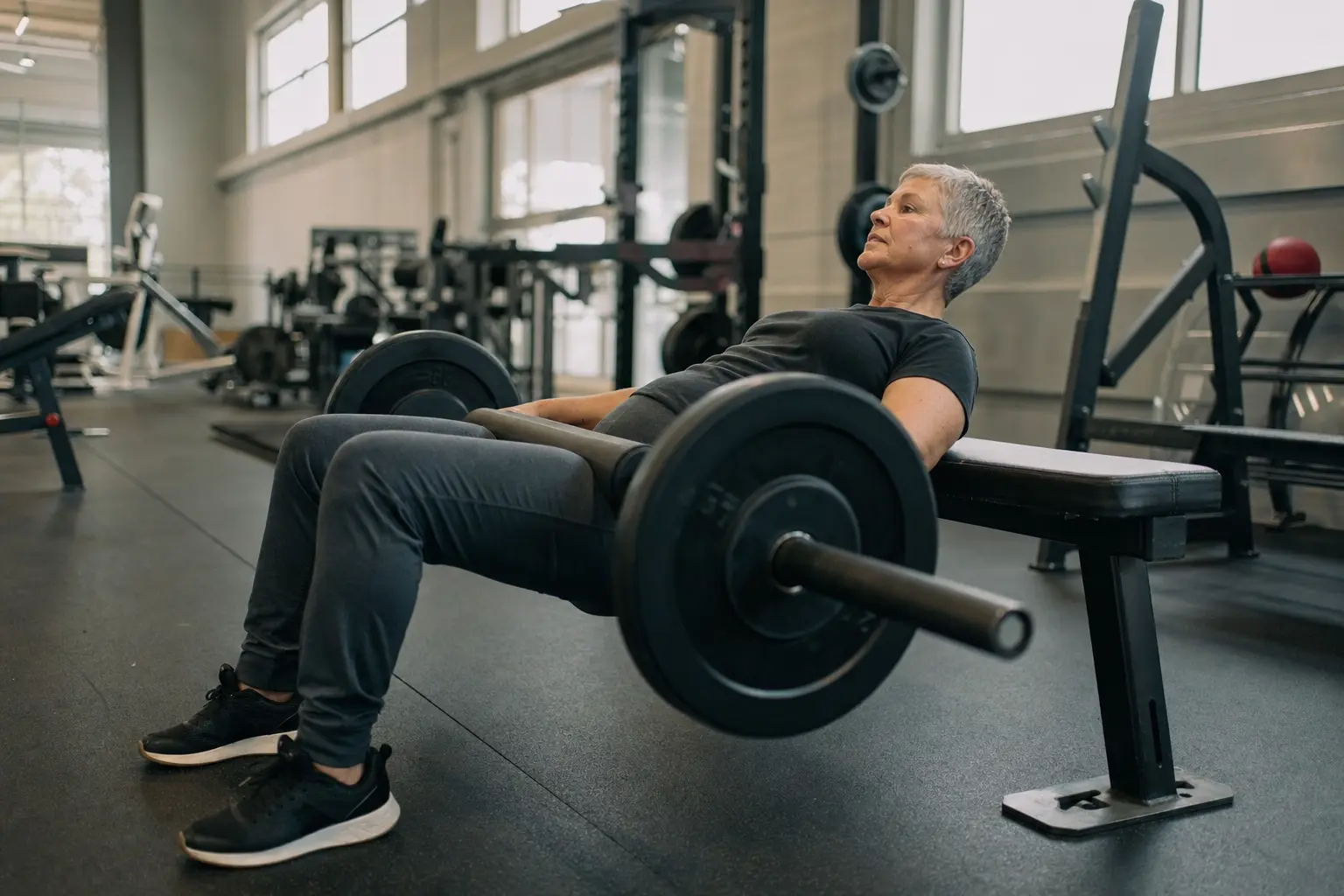
To do a hip thrust, sit on the floor with your upper back against a bench and a weight across your hips. Plant your feet, then push through your heels until your hips are level with your shoulders and knees. Squeeze your glutes at the top for a moment, then lower with control. Start with your body weight or a light dumbbell, and move to a barbell hip thrust once the form feels steady.
- Set up the bench. Use a bench about knee height that can't slide, such as one pushed against a wall. Sit on the floor with the bottom of your shoulder blades against its edge.
- Place the weight. Roll a padded barbell over your legs until it sits in the crease of your hips. Hold the bar with both hands so it stays put.
- Set your feet. Plant your feet flat, about shoulder-width apart. Place them so your shins are close to upright when your hips are at the top.
- Lift your hips. Tuck your chin and brace your core. Push through your heels until your body makes a straight line from your shoulders to your knees.
- Pause, then lower. Squeeze your glutes for a second at the top. Lower your hips with control, then start the next rep.
What a hip thrust is
A hip thrust is a hip lift with your upper back on a bench and a weight across your hips. You let your hips sink toward the floor, then drive them up until your body is flat like a table. The bench gives your hips room to travel, and the weight sits right over the muscles doing the work.
If the move is new to you, learn the glute bridge on the floor first. It’s the same hip lift with a shorter range and nothing to set up.
Hip thrust form: a quick check
| Body part | What to aim for |
|---|---|
| Upper back | The bottom of your shoulder blades on the edge of the bench. Your body pivots there |
| Feet | Flat and about shoulder-width apart, with your shins close to upright at the top |
| Chin and ribs | Chin tucked and ribs down. Your head and chest move as one piece |
| Hips | Level with your shoulders and knees at the top. Don’t arch your lower back to go higher |
| Bar | In the crease of your hips, with a thick pad or a folded mat under it |
Film one set from the side with your phone. You’ll see whether your shins are upright and whether your hips reach a straight line.
What muscles do hip thrusts work?
Hip thrusts mostly work the gluteus maximus, the largest of the glute muscles. Your hamstrings help, and the front of your thighs works too.
In one study, 13 trained women did barbell hip thrusts and back squats with a weight they could lift about 10 times. Sensors on the skin recorded the average activity of each muscle:
| Muscle | Barbell hip thrust | Back squat |
|---|---|---|
| Upper gluteus maximus | 69.5% | 29.4% |
| Lower gluteus maximus | 86.8% | 45.4% |
| Hamstrings (biceps femoris) | 40.8% | 14.9% |
| Front of the thigh (vastus lateralis) | 99.5% | 110% |
The gap in the front of the thigh was too small to count as a real difference. A 2019 review of 12 studies agreed that the hip thrust shows more glute and hamstring activity than the squat.
More activity in one set isn’t the same as more growth, though. In a 2023 study, 34 college-aged beginners trained with either hip thrusts or back squats for 9 weeks. Their glutes grew by a similar amount in both groups. The squat group grew more thigh muscle, and each group gained the most strength in the lift it practiced. So the hip thrust is a good glute lift, not a magic one. It works well next to a squat.
Another study, of 20 trained women, found the hip thrust works the glutes hardest at the top, with the hips straight. The Bulgarian split squat worked them hardest at the bottom. The authors suggested doing both, so the glutes work across the whole range.
How soon you notice a change differs from person to person. See how long it takes to see results from working out and how to grow your glutes.
Hip thrust variations
| Version | How it differs | Good for |
|---|---|---|
| Barbell hip thrust | A padded bar across your hips | Adding load in small steps |
| Dumbbell hip thrust | One dumbbell held on your hips | Starting out, or training at home |
| Hip thrust machine | A padded belt or pad takes the place of the bar | Quick setup, with no bar to roll over your legs |
| Smith machine hip thrust | The bar runs on rails | A bar that can’t roll. Place the bench so the bar ends up over your hips |
| Banded hip thrust | A loop band above your knees, or a long band across your hips | Light days and travel |
| B stance hip thrust | One foot planted, the other resting on its heel a little ahead | More work for one leg, with some help for balance |
| Single leg hip thrust | One foot planted, the other leg in the air | Making body weight or a light dumbbell hard |
| Hip thrusts at home | Your upper back on a couch pushed against a wall | Training with no gym |
A 2020 review placed both the barbell and the band hip thrust in its top group for glute activity. In a 2023 study of 14 female footballers, a loaded single leg hip thrust ranked in the top group for force in the gluteus maximus, next to the split squat and the single-leg RDL.
How much weight should you start with?
Start with no weight. When you can do 12 reps with a pause at the top of each, hold one dumbbell on your hips. After that, move to an empty barbell. See how much a barbell weighs to know what you’re lifting.
Pick a load you could lift for a couple more reps than you plan to do. The ACSM’s 2009 guide suggests adding 2 to 10% once you can do one or two reps more than your target. That steady climb is progressive overload. The plate calculator shows what to put on each side of the bar, and how much weight should I lift covers starting points for other lifts.
A simple hip thrust workout
Start with 2 or 3 sets of 8 to 12 reps, two days a week. Rest 1 to 2 minutes between sets. The ACSM’s 2009 guide gives beginners 8 to 12 reps, and its 2026 position stand advises at least two sets per exercise and training at least twice a week. The 2026 paper also found that muscle growth was helped by 10 or more sets a week. Your other glute lifts count toward that number.
Here is a glute day built around the hip thrust:
| Exercise | Sets and reps |
|---|---|
| Hip thrust | 3 sets of 8 to 12 |
| Romanian deadlift | 3 sets of 8 to 12 |
| Bulgarian split squat | 2 sets of 8 to 12 each leg |
| Glute kickbacks | 2 sets of 10 to 12 each leg |
For more options, see a good glute workout and how many sets and reps build muscle.
Common mistakes, and fixes
| Mistake | Try |
|---|---|
| You feel it in your lower back | Tuck your chin and keep your ribs down. Stop when your hips are level, not higher |
| You feel it mostly in your thighs | Move your feet a little farther from the bench |
| You feel it mostly in your hamstrings | Move your feet a little closer to the bench |
| The bar digs into your hips | Use a thicker pad, or switch to a dumbbell for now |
| The bench slides | Push it against a wall or a rack |
| Your hips stop short of level | Take some weight off and pause at the top of every rep |
Glute bridge vs hip thrust
They are the same hip lift with one change. In a glute bridge your shoulders rest on the floor, so the range is short and you need no bench. In a hip thrust your shoulders rest on a bench, so your hips travel farther.
A study of 10 men compared the barbell versions. The glute bridge showed more glute activity, and the hip thrust showed more activity in the front of the thigh. The authors noted that nobody had yet tested which one builds more muscle over time. So pick by what you have and what feels good. The glute bridge guide covers the floor version in full.
Hip thrust alternatives
- Glute bridge. The same move on the floor. The closest swap when there’s no bench.
- Romanian deadlift. Works your glutes and hamstrings while they are stretched.
- Bulgarian split squat. One leg at a time, hardest at the bottom.
- Back extension. A hip hinge on a 45 degree bench.
The full list is in the best glute exercises.
Safety
Push the bench against something solid before you load the bar, and pad the bar well. Keep your chin tucked and stop at a straight line, so your lower back doesn’t arch. Warm up with a set or two of body weight reps. Stop if you feel sharp pain in your back or hips, and see a doctor or physical therapist if it keeps happening.
Also asked
What muscles do hip thrusts work?
Mostly your glutes. Your hamstrings and the front of your thighs help. In a study of 13 trained women, the barbell hip thrust showed more glute and hamstring activity than the back squat. Activity in the front of the thigh was about the same.
How much weight should I start with on hip thrusts?
Start with your body weight until you can pause at the top of every rep. Then hold a dumbbell on your hips or use an empty barbell. Pick a load you could lift for a couple more reps than you plan to do.
Are hip thrusts better than squats for glutes?
Not clearly. A 9-week study of 34 beginners found that hip thrusts and back squats grew the glutes by a similar amount. Squats grew the thighs more. Many people do both.
Can you do hip thrusts at home?
Yes. Rest your upper back on a couch or a sturdy chair pushed against a wall. Hold a dumbbell or a loaded backpack on your hips. One leg at a time makes body weight harder.
What is a B stance hip thrust?
One foot stays planted and does most of the work. The other foot slides forward and rests on its heel for balance. It's a step between the two-leg version and the single leg hip thrust.
Is the hip thrust machine as good as a barbell hip thrust?
It trains the same movement. A hip thrust machine has a padded belt or pad across your hips in place of a bar, so it's quicker to set up. We found no study that compares the two, so use the one you like and can keep adding load to.
What is a good hip thrust alternative?
The glute bridge is the closest, since it's the same move with your shoulders on the floor. Romanian deadlifts, Bulgarian split squats, back extensions and cable kickbacks also train your glutes.
How often should I do hip thrusts?
Twice a week is a good start. A 2026 position stand from the American College of Sports Medicine advises at least two sets per exercise and training at least twice a week.
Sources
- Contreras et al. (2015), A Comparison of Gluteus Maximus, Biceps Femoris, and Vastus Lateralis Electromyographic Activity in the Back Squat and Barbell Hip Thrust Exercises
- Neto et al. (2019), Barbell Hip Thrust, Muscular Activation and Performance: A Systematic Review
- Plotkin et al. (2023), Hip thrust and back squat training elicit similar gluteus muscle hypertrophy and transfer similarly to the deadlift
- McCurdy et al. (2021), Hip and Knee Extensor Activation During the Hip Thrust and Rear-Foot-Elevated Split Squat in Trained Females
- Neto et al. (2020), Gluteus Maximus Activation during Common Strength and Hypertrophy Exercises: A Systematic Review
- Collings et al. (2023), Gluteal Muscle Forces during Hip-Focused Injury Prevention and Rehabilitation Exercises
- Kennedy et al. (2024), Electromyographic differences of the gluteus maximus, gluteus medius, biceps femoris, and vastus lateralis between the barbell hip thrust and barbell glute bridge
- Currier et al. (2026), American College of Sports Medicine position stand: Resistance training prescription for muscle function, hypertrophy, and physical performance in healthy adults
- American College of Sports Medicine (2009), Progression models in resistance training for healthy adults