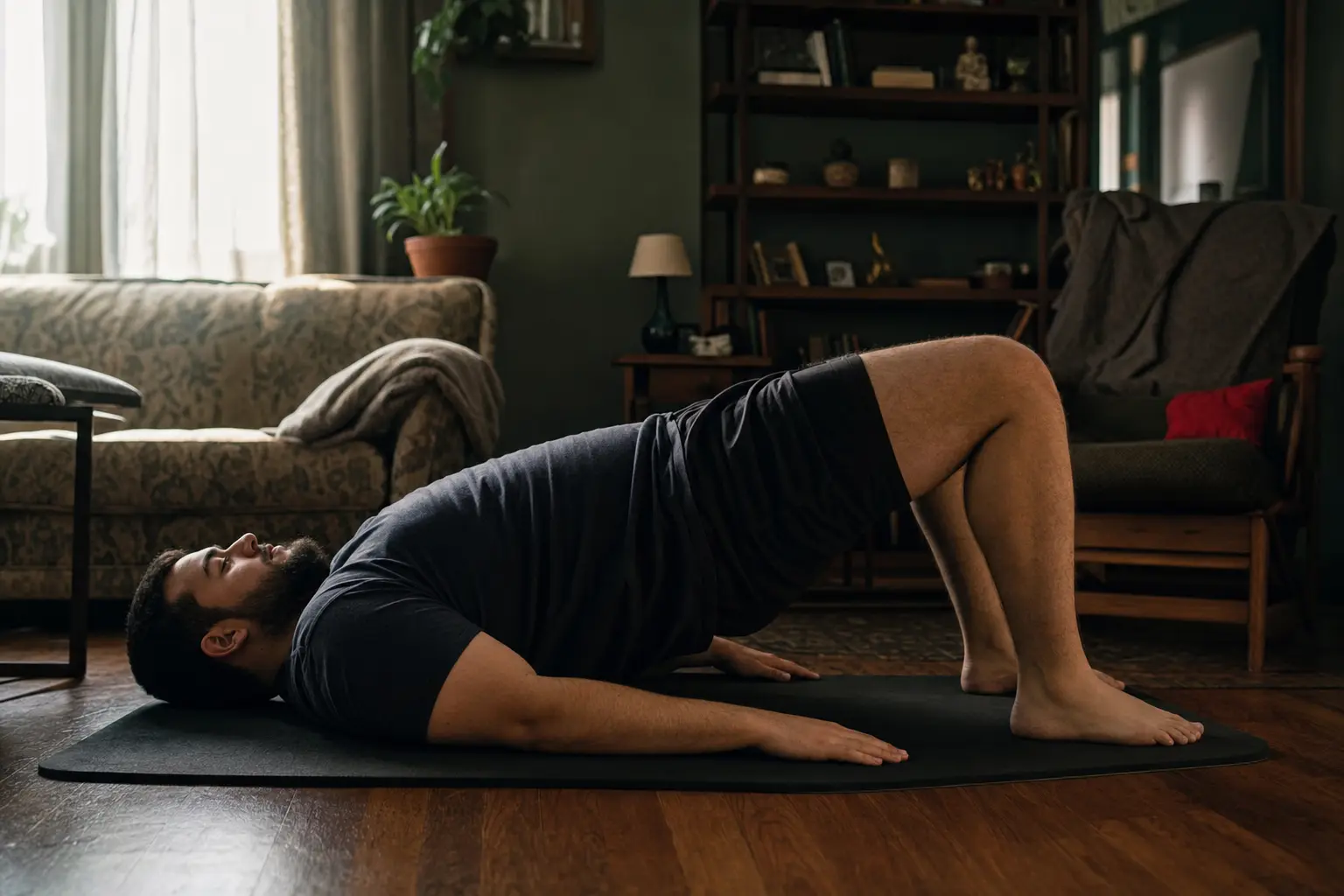
 AI-generated image
Guides · Strength training · Updated 2026-11-12
How do you do a glute bridge?
To do a glute bridge, lie on your back with your knees bent and your feet flat on the floor, about hip-width apart. Push through your heels and lift your hips until your body makes a straight line from your shoulders to your knees. Squeeze your glutes for a second, then lower slowly. Glute bridges need no equipment, and you can add weight or use one leg at a time when they get easy.
- Lie down. Lie on your back on a mat with your knees bent. Rest your arms on the floor at your sides, palms down.
- Set your feet. Place your feet flat and about hip-width apart. Bring your heels close enough that your shins are near upright at the top.
- Brace. Tighten your core and press your lower back gently toward the floor. Keep your chin tucked.
- Lift your hips. Push through your heels and squeeze your glutes. Stop when your body is straight from your shoulders to your knees.
- Pause, then lower. Hold the top for a second. Lower your hips slowly until they almost touch the floor, then go again.
What a glute bridge is
A glute bridge is a hip lift done lying on your back. Your shoulders and feet stay on the floor while your hips rise until your body is straight from shoulders to knees. It needs no equipment and very little space, so it’s one of the easiest glute exercises to start with.
Glute bridges mostly work your glutes and your hamstrings. The muscles around your trunk hold everything steady.
Glute bridge form: a quick check
| Body part | What to aim for |
|---|---|
| Feet | Flat and about hip-width apart, with your weight toward your heels |
| Knees | In line with your hips and feet. Don’t let them fall in or out |
| Ribs and lower back | Ribs down, with no big arch in your lower back at the top |
| Hips | In line with your shoulders and knees at the top, and level from side to side |
| Head | Resting on the floor with your chin slightly tucked |
How hard do glute bridges work your glutes?
With body weight alone, not very hard. In a study of 30 healthy adults, the body weight bridge kept every muscle measured under 45% of its top effort. The authors said that level suits endurance more than strength.
That doesn’t make bridges a waste of time. In an 8-week study, 32 university students did either two-leg bridges or glute squeezes every day. Both groups got stronger at straightening the hip. A 2017 review also found that light loads built similar muscle to heavy ones when sets were taken close to failure.
So the plain bridge is where you start, not where you stay. When 12 reps feel easy, pick a harder version from the table below. Adding a little more over time is progressive overload.
Glute bridge variations
| Version | How to do it | Makes it |
|---|---|---|
| Glute bridge hold | Lift your hips and stay at the top | Harder without more reps |
| Glute bridge march | Hold the top and lift one foot, then the other | A step toward one leg |
| Single leg glute bridge | One foot on the floor, the other leg in the air | Much harder with no weight |
| Banded glute bridge | A loop band just above your knees. Press out against it | More work for the sides of your hips |
| Dumbbell glute bridge | One dumbbell resting on your hips, held with both hands | Heavier in small steps |
| Barbell glute bridge | A padded bar across your hips | As heavy as you need |
| Short-range bridge on a bench | Back on a bench, hips moving only a little way | Slow, steady work near the top |
The last one is sometimes called a Kas glute bridge. It looks like a hip thrust with a small, slow movement near the top.
The single leg glute bridge
Lift one foot off the floor and bridge on the other leg. Keep your hips level, as if you had a glass of water resting on them. Do the same reps on each side, starting with your weaker one.
A study of 28 healthy adults tested where to put the working foot. With the heel pulled in close, so the knee was bent more, hamstring activity fell from about 75% to about 23% of its max. Glute activity stayed about the same, at about half of its max. So if a bridge makes your hamstrings do all the work, slide your heels a little closer to your hips.
The weighted glute bridge
Rest a dumbbell or a padded barbell in the crease of your hips and hold it with both hands. A folded mat under the bar makes it kinder on your hip bones. Start with a weight you could lift for a couple more reps than you plan to do.
With full-size plates you can usually roll the bar over your legs. With small plates the bar sits lower, so lift it onto your lap before you lie back.
Sets and reps
Start with 2 or 3 sets of 8 to 12 reps, two or three days a week. The ACSM’s 2009 guide gives beginners 8 to 12 reps on 2 or 3 days a week. Its 2026 position stand advises at least two sets per exercise and training at least twice a week.
For weighted bridges, the 2009 guide suggests adding 2 to 10% once you can do one or two reps more than your target. For more on the numbers, see how many sets and reps build muscle.
Glute bridge vs hip thrust
They are the same hip lift. In a glute bridge your shoulders rest on the floor, so the range is short and you need no bench. In a hip thrust your shoulders rest on a bench, so your hips travel farther.
| Glute bridge | Hip thrust | |
|---|---|---|
| Shoulders | On the floor | On a bench |
| Range of motion | Shorter | Longer |
| Setup | A mat | A steady bench, and often a barbell |
| Good for | Learning the move, training at home | Adding load over months |
A study of 10 men compared the barbell versions of both. The glute bridge showed more activity in the gluteus maximus, and the hip thrust showed more in the front of the thigh. The authors noted that nobody had yet tested which one builds more muscle over time. So the bridge is not just the beginner version. Both are worth doing, and the hip thrust guide covers the bench version.
Common mistakes, and fixes
| Mistake | Try |
|---|---|
| Your lower back arches at the top | Keep your ribs down and stop when your hips are level |
| You feel it mostly in your hamstrings | Slide your heels closer to your hips |
| Your knees fall inward | Press them out in line with your feet, or use a loop band as a reminder |
| You push through your toes | Lift your toes a little and drive through your heels |
| Your hips tilt on one leg | Go back to the march until you can stay level |
Where glute bridges fit in a workout
Body weight bridges work well in a warm-up before squats or deadlifts, or in a home session with no equipment. The leg workout without equipment shows one way to use them. Weighted bridges belong with your main glute lifts. See the best glute exercises for the full list and a good glute workout for a plan.
Muscle grows when you train it hard and eat enough protein and enough food. The protein calculator gives you a daily number. How soon you notice a change differs from person to person, as how long it takes to see results explains.
Safety
Move slowly and stop at a straight line. Your lower back shouldn’t arch, and your neck should stay relaxed on the floor. Stop if you feel sharp pain anywhere, and see a doctor or physical therapist if it keeps happening.
Also asked
What muscles do glute bridges work?
Mostly your glutes and your hamstrings. The muscles around your trunk work to keep your body in a straight line.
Are glute bridges enough to build your glutes?
They're a good start. In a study of 30 healthy adults, the body weight bridge kept every muscle measured under 45% of its top effort. The authors said that level suits endurance more than strength. Once bridges feel easy, add weight or use one leg.
What is a Kas glute bridge?
It's a short-range bridge with your back on a bench, sometimes called a Kas glute bridge. You set up like a hip thrust and lower your hips only a little way. Then you squeeze back to the top slowly. It uses less weight than a full hip thrust.
What is a glute bridge march?
You hold the top of a bridge and lift one foot off the floor, then the other, as if marching in place. Your hips stay level the whole time. It's a step toward the single leg glute bridge.
How long should you hold a glute bridge?
We found no research that sets a number. Hold the top for as long as your hips stay level and your glutes stay tight, and stop when your hips start to drop. Try to hold a little longer from week to week.
Why do I feel glute bridges in my hamstrings?
Your feet may be too far from your hips. In a study of 28 healthy adults doing single leg bridges, pulling the heel in closer cut hamstring activity from about 75% to about 23% of its max. Glute activity stayed about the same.
Is a glute bridge the same as a hip thrust?
It's the same hip lift. In a glute bridge your shoulders are on the floor. In a hip thrust they rest on a bench, so your hips travel farther.
How many glute bridges should I do?
Start with 2 or 3 sets of 8 to 12 reps, two or three days a week. Those numbers follow the American College of Sports Medicine's advice for beginners.
Sources
- Ekstrom et al. (2007), Electromyographic analysis of core trunk, hip, and thigh muscles during 9 rehabilitation exercises
- Lehecka et al. (2017), Building a better gluteal bridge: electromyographic analysis of hip muscle activity during modified single-leg bridges
- Lehecka et al. (2019), The effects of gluteal squeezes compared to bilateral bridges on gluteal strength, power, endurance, and girth
- Kennedy et al. (2024), Electromyographic differences of the gluteus maximus, gluteus medius, biceps femoris, and vastus lateralis between the barbell hip thrust and barbell glute bridge
- Schoenfeld et al. (2017), Strength and hypertrophy adaptations between low- vs. high-load resistance training, a systematic review and meta-analysis
- Currier et al. (2026), American College of Sports Medicine position stand: Resistance training prescription for muscle function, hypertrophy, and physical performance in healthy adults
- American College of Sports Medicine (2009), Progression models in resistance training for healthy adults