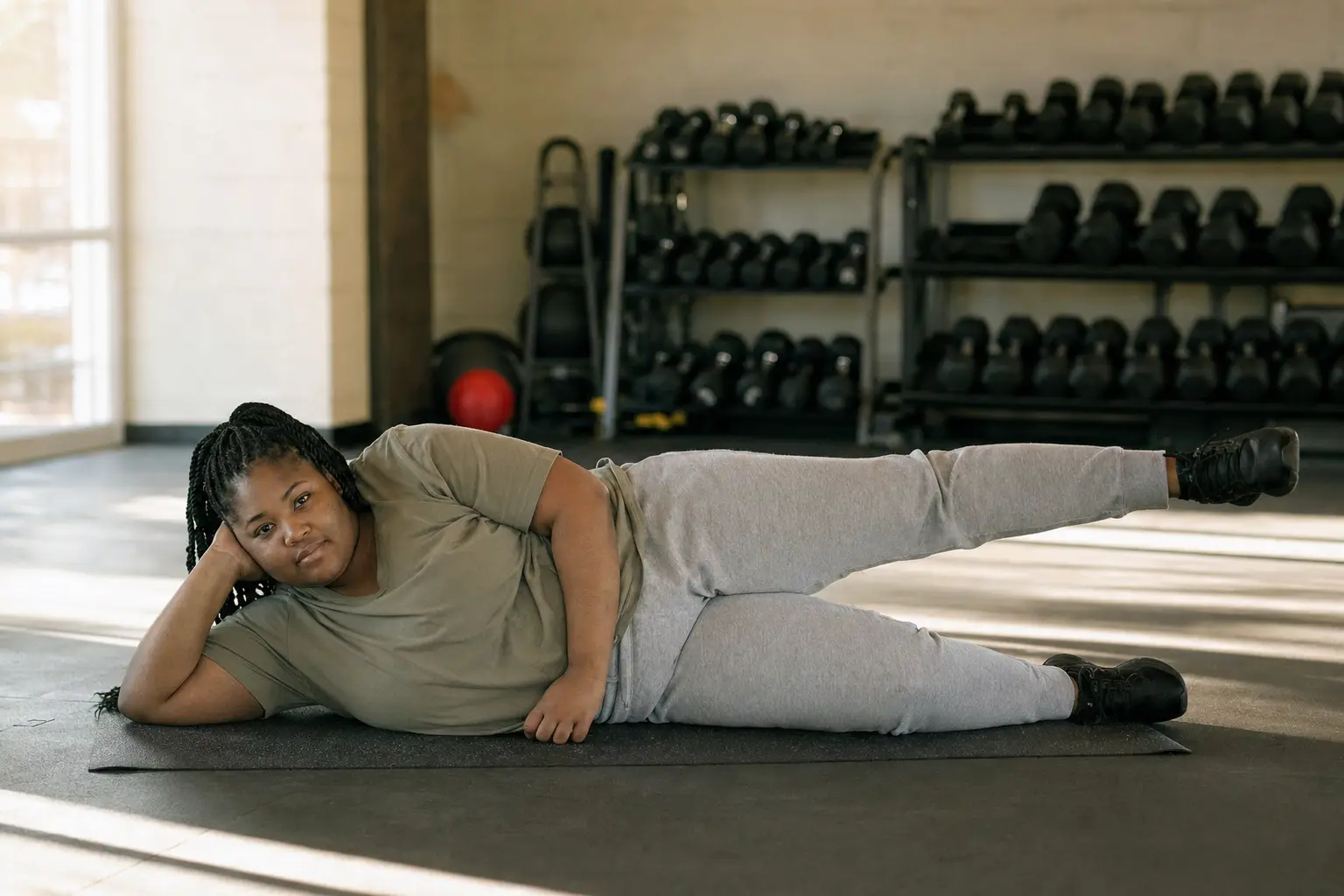
 AI-generated image
Guides · Strength training · Updated 2026-11-12
What are the best gluteus medius exercises?
The best gluteus medius exercises are side lying hip abduction, the side plank with hip abduction, single-leg squats and banded side steps. In lab studies that measured muscle activity, these all worked the gluteus medius hard. Pick two or three of them and do 2 or 3 sets of 8 to 12 reps, twice a week. Make them a little harder over time.
- Warm up. Walk or march for a few minutes, then do a few easy body weight squats.
- Start with a standing move. Do single-leg squats to a chair or lateral step-ups. Aim for 2 or 3 sets of 8 to 12 reps on each leg.
- Then lie on your side. Do side lying hip abduction or the side plank with hip abduction. Aim for 2 or 3 sets on each side.
- Finish with a band. Do banded side steps, with the same number of steps each way.
- Log it. Write down your reps and the band or weight you used, so next time you know what to beat.
What the gluteus medius does
The gluteus medius is a fan-shaped muscle on the side of your hip. The gluteus minimus is a smaller muscle that lies under it. People often shorten the name to “glute med”. In the gym, the same area gets called the side glutes or the upper glutes.
It has two main jobs:
- It moves your leg out to the side and helps turn it.
- It holds your pelvis level when you’re on one leg, which happens with every step you take.
So the best gluteus medius exercises do one of two things. They lift the leg out to the side against some load, or they make you balance on one leg.
The best gluteus medius exercises, by muscle activity
Researchers put sensors on the muscle and measure how hard it works in each exercise. The score is a percent of the hardest the muscle can squeeze in a test. A higher number means the muscle is doing more.
| Exercise | What you need | Gluteus medius activity |
|---|---|---|
| Side plank with hip abduction | A mat | 89 to 103%, the highest of 18 exercises in one study |
| Single-leg squat | A chair or bench | 64 to 82% |
| Side lying hip abduction | A mat | 63 to 81%, the best of 12 exercises in one study |
| Harder clamshell, top leg held up | A mat | 77% |
| Lateral step-up | A low step | About 60% |
| Single-leg deadlift | Nothing, or a dumbbell | 59% |
| Hip hitch | A low step | About 58% |
| Banded side step | A loop band | Over 40% in a review of 56 studies |
| Lunge | Nothing, or dumbbells | 48% |
| Basic clamshell | A mat | 38 to 40% |
Most of the numbers come from two lab studies of healthy adults, one with 21 people and one with 24. Each lab tested in its own way, so don’t read much into small gaps. Muscle activity is also a clue, not proof, of what builds the most muscle. Any move in the top half of the table is a fair pick.
A separate study used fine wires in the muscle to compare the glutes with the tensor fasciae latae, a small muscle at the front of the hip that also lifts the leg sideways. The clamshell and the side step stood out for working the glutes much more than that muscle.
How to do each move
Side lying hip abduction. Lie on your side with your bottom knee bent. Keep your top leg straight with your toes pointing forward. Lift it, then lower it slowly.
Side plank with hip abduction. Lie on your side, propped on your elbow. Lift your hips so your body makes a straight line. Raise your top leg and lower it. Stay in the plank the whole time. It’s hard, so start with the easier version below.
Single-leg squat to a chair. Stand on one leg in front of a chair. Lower yourself slowly until you touch the seat, then stand back up. Keep your knee in line with your toes.
Banded side step. Put a loop band around your ankles and bend your knees a little. Step sideways and follow with the other foot. Keep the band tight. Do the same number of steps each way.
Hip hitch. Stand with one foot on a low step and the other foot hanging off the side. Keep both knees straight. Let the hanging side drop a little, then pull it back up level using the hip you’re standing on.
The single-leg RDL and the glute bridge have their own guides, with one-leg versions of each.
Easier and harder versions
| Exercise | Easier | Harder |
|---|---|---|
| Side lying hip abduction | Smaller lifts | A loop band around your ankles |
| Side plank with hip abduction | Bottom knee on the floor | Lower the top leg more slowly |
| Single-leg squat | A higher seat and a hand on a wall | A lower seat, or hold a dumbbell |
| Banded side step | Band above your knees | Band around your feet |
| Hip hitch | Hold a wall | Hold a dumbbell on the hanging side |
Gluteus minimus exercises
You don’t need a separate list. A 2020 review of 56 studies looked at which exercises work each part of the two muscles at a high level, which it set at more than 40% of max.
| Part of the hip | Exercises that reached a high level |
|---|---|
| Every part of the gluteus medius | Hip hitch |
| Middle of the gluteus medius | Single-leg bridge, lateral step-up, banded side step, standing hip abduction with resistance |
| Every part of the gluteus minimus | Hip hitch, standing hip abduction held against resistance |
| Back of the gluteus minimus | Side lying hip abduction, plus the single-leg bridge and the single-leg squat |
Upper glute workout and side glute exercises
“Upper glutes” and “side glutes” aren’t separate muscles. The area is the gluteus medius plus the top part of the gluteus maximus. Hip abduction trains both. In a 2026 study, 17 young adults did cable hip abduction twice a week for 10 weeks. The upper part of the gluteus maximus grew about 10%, and the gluteus medius and minimus together grew about 4%.
Add this to the end of a leg day or a glute workout:
| Exercise | Sets and reps |
|---|---|
| Hip abduction machine or cable hip abduction | 3 sets of 8 to 12 |
| Single-leg squat to a bench | 2 sets of 8 to 12 each leg |
| Side plank with hip abduction | 2 sets of 8 to 12 each side |
| Banded side step | 2 sets of 8 to 12 steps each way |
At home, swap the first move for side lying hip abduction.
A note on shape. Your bones set the outline of your hips, and muscle and body fat sit on top. Training can grow the muscle. It can’t change bone, and nobody can pick where fat goes. For the whole picture, see how to grow your glutes and the best glute exercises.
Sets and reps
Do 2 or 3 sets of 8 to 12 reps, twice a week. A 2026 position stand from the American College of Sports Medicine (ACSM) advises at least two sets per exercise and training at least twice a week. Its 2009 guide suggests 8 to 12 reps for people who are new to lifting.
When you can do one or two reps more than your target, make it harder. With weights, the 2009 guide suggests adding 2 to 10%. With body weight moves, go to the harder version in the table above. That steady climb is progressive overload. Muscle also needs enough food and enough protein to grow. The protein calculator gives you a daily number.
Growth takes patience. See how long it takes to see results.
Safety
This is a guide to training, not to the care of an injury. If a hip or knee already hurts, see a doctor or physical therapist before you start. Hold a wall or a rail for the one-leg moves until your balance is steady. Stop if you feel sharp pain.
Also asked
What does the gluteus medius do?
It moves your leg out to the side and helps turn it. It also holds your pelvis level when you stand on one leg, which happens with every step you take.
What is the best exercise for the gluteus medius?
There isn't one winner. In one lab study of 12 exercises, side lying hip abduction came out best. In another study of 18 exercises, the side plank with hip abduction ranked highest, ahead of the single-leg squat.
What are the best gluteus minimus exercises?
The same ones. A 2020 review of 56 studies found that the hip hitch worked every part of both the gluteus medius and the gluteus minimus at a high level. Standing hip abduction held against resistance did the same for the gluteus minimus.
Are clamshells good glute med exercises?
The basic clamshell is a gentle start, at 38 to 40% of the muscle's max in one study. A harder version with the top leg held up reached 77% in another. In a third study, the clamshell worked the glutes much more than the muscle at the front of the hip.
What exercises work the upper glutes and side glutes?
Hip abduction moves, where your leg goes out to the side. In a 2026 study, 10 weeks of cable hip abduction grew the upper part of the gluteus maximus by about 10%, and the gluteus medius and minimus together by about 4%. Results differ from person to person.
How often should I train my gluteus medius?
Twice a week is a good start. A 2026 position stand from the American College of Sports Medicine advises at least two sets per exercise and training at least twice a week.
Can I do gluteus medius exercises at home?
Yes. Side lying hip abduction, the side plank with hip abduction, single-leg squats to a chair and the hip hitch on a stair need no equipment.
Do squats and deadlifts work the gluteus medius?
One-leg versions do. In one lab study, the single-leg squat reached 64% of the muscle's max for the gluteus medius, and the single-leg deadlift reached 59%.
Sources
- Distefano et al. (2009), Gluteal muscle activation during common therapeutic exercises
- Boren et al. (2011), Electromyographic analysis of gluteus medius and gluteus maximus during rehabilitation exercises
- Selkowitz et al. (2013), Which exercises target the gluteal muscles while minimizing activation of the tensor fascia lata? Electromyographic assessment using fine-wire electrodes
- Moore et al. (2020), A systematic review and meta-analysis of common therapeutic exercises that generate highest muscle activity in the gluteus medius and gluteus minimus segments
- Macadam et al. (2015), An examination of the gluteal muscle activity associated with dynamic hip abduction and hip external rotation exercise: a systematic review
- Flack et al. (2012), A review of the anatomy of the hip abductor muscles, gluteus medius, gluteus minimus, and tensor fascia lata
- Attarieh et al. (2026), Regional Hypertrophy of the Gluteal Muscles Is Task-Specific: Differential Responses to 10 Weeks of Hip Extension Versus Hip Abduction Training
- Currier et al. (2026), American College of Sports Medicine position stand: Resistance training prescription for muscle function, hypertrophy, and physical performance in healthy adults
- American College of Sports Medicine (2009), Progression models in resistance training for healthy adults