 AI-generated image
Guides · Strength training · Updated 2026-11-09
How do you do a Jefferson curl?
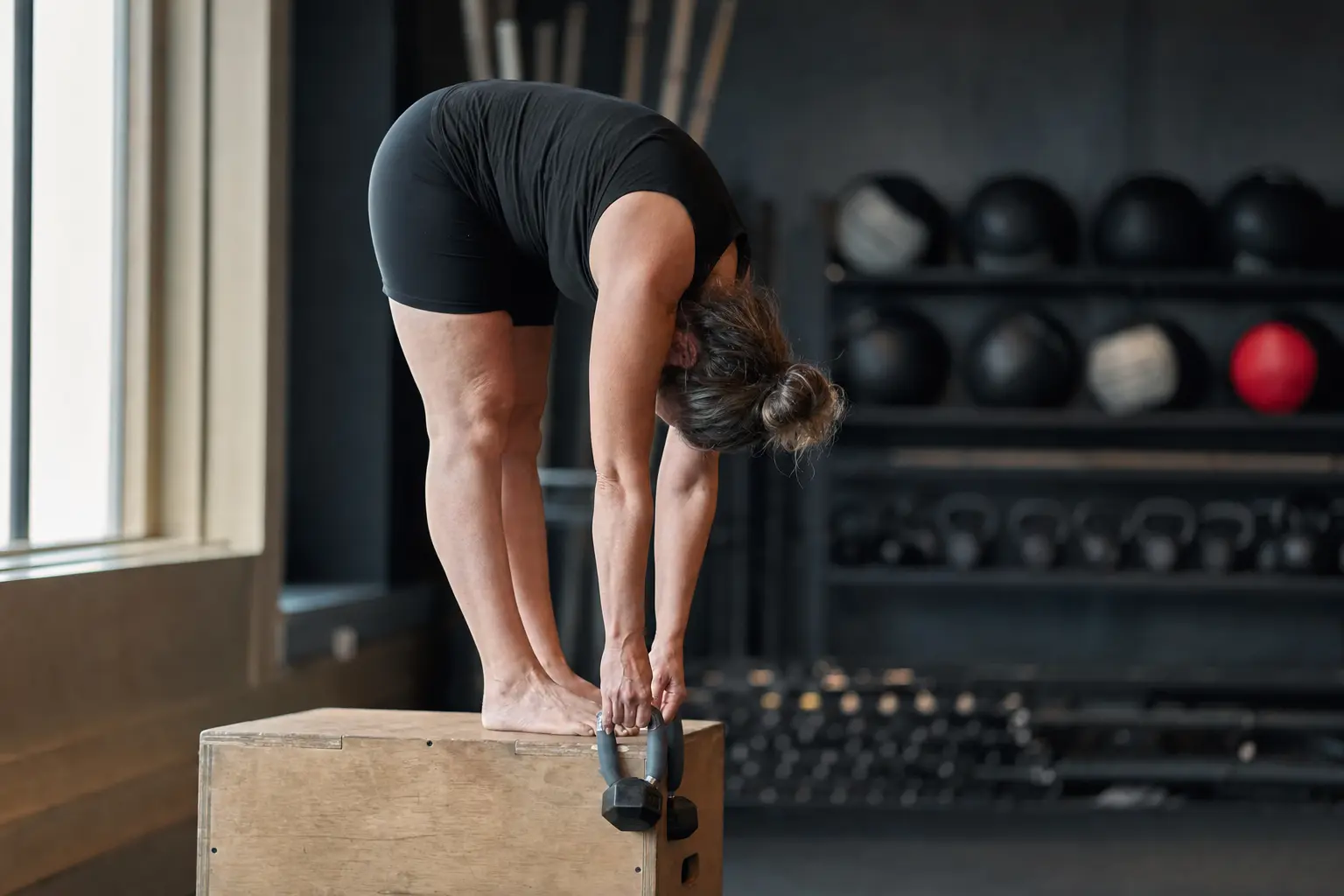
A Jefferson curl is a slow forward bend where you roll your spine down one section at a time while holding a light weight, then roll back up. Stand on a box or step so the weight can travel past your feet, and keep your legs nearly straight. Go only as low as feels comfortable. Start with no weight or a very light one, for 2 sets of 5 slow reps.
- Stand on a box. Stand on a sturdy box or step with your feet about hip-width apart. Hold a light dumbbell or plate in front of your thighs with straight arms.
- Tuck your chin. Start the movement by bringing your chin down to your chest.
- Roll down slowly. Let your upper back round forward first, then your lower back, one section at a time. Keep a soft bend in your knees and let the weight hang straight down.
- Find your bottom. Go as low as feels comfortable. The weight may pass your toes. Pause there for a second and keep breathing.
- Roll back up. Reverse it slowly. Stack your lower back first and your upper back next. Lift your head last.
What a Jefferson curl is
A Jefferson curl is a standing forward bend with a weight in your hands. Instead of keeping your back flat, as in a deadlift, you curl your spine down one section at a time, starting with your head. Standing on a box lets you go lower than your feet.
People use it to build strength through a range of motion that most lifts avoid, and to stretch the backs of their legs.
What the research says
There isn’t much. A 2026 study in the International Journal of Sports Physical Therapy describes the Jefferson curl as popular but barely studied. The researchers had 21 trained adults do the Jefferson curl and a Romanian deadlift at the same weight, about 42 kg (92 lb) on average. Sensors on the skin showed the Jefferson curl worked the upper and lower back muscles and the hamstrings harder. Glute work was about the same.
The study tested how hard the muscles worked, not whether the exercise prevents or causes injuries. Its lifters trained at least three times a week and had no recent back pain. They were also watched for discomfort on every rep. So start lighter than they did.
Common mistakes, and fixes
| Mistake | Try |
|---|---|
| Going too heavy | Use no weight, or the lightest weight you have, until the movement feels smooth |
| Bending your knees a lot | Keep a soft bend only. Deep knee bends turn it into a different lift |
| Dropping fast or bouncing at the bottom | Take several seconds to roll down, and pause before you come up |
| Keeping your back flat and hinging at the hips | Tuck your chin first and roll down one section at a time |
Easier and harder versions
- Easier: no weight. Do the same slow roll-down with empty hands, letting your arms hang.
- Easier: on the floor. Stand on the floor instead of a box, so you only go as far as your toes.
- Harder: a little more weight. Add weight in small steps once 5 slow reps feel easy.
- Harder: a slower lowering. Take longer on the way down and pause longer at the bottom.
Sets and reps to start with
Start with 2 sets of 5 slow reps, two days a week, with no weight or a very light one. Five reps per set is what the 2026 study used. A 2026 position stand from the American College of Sports Medicine advises at least two sets per exercise and training at least twice a week.
Add weight slowly. The ACSM’s 2009 guide suggests increases of 2 to 10% once you can do a rep or two more than your target. For the Jefferson curl, the low end of that is a good rule.
Safety
If you have back pain or a condition that affects your bones, check with a doctor or physical therapist before you try this. Stand on a box that won’t tip. Move slowly and never bounce. Stop if you feel sharp pain or pain that runs down a leg.
For a gentler stretch for the front of your hips, try the couch stretch. For the backs of your legs, the Nordic hamstring curl builds strength.
Also asked
Is the Jefferson curl safe?
For healthy people who start light and move slowly, it can be. Bending the spine under load has long been seen as risky, and there's very little research on this exercise. The one study we found tested trained lifters with no recent back pain, and every rep was slow and controlled. If you have back pain or a back injury, check with a doctor or physical therapist first.
What muscles does the Jefferson curl work?
Mostly the muscles along your spine and your hamstrings. In a 2026 study of 21 trained lifters, the Jefferson curl worked the upper and lower back muscles and the hamstrings harder than a Romanian deadlift at the same weight. Glute work was about the same.
How heavy should a Jefferson curl be?
Light. Start with no weight at all, then a small dumbbell or plate. In the 2026 study, trained lifters worked up to a weight that felt hard for 5 reps, and that averaged about 42 kg (92 lb). Most people never need to go near that.
What's the difference between a Jefferson curl and a Romanian deadlift?
In a Romanian deadlift you keep your back flat and hinge at the hips. In a Jefferson curl you round your spine on purpose, one section at a time, and the hips do less. The Romanian deadlift is the one to load heavy.
Sources
- Yona et al. (2026), Surface EMG characterization of the Jefferson curl at a submaximal load matched to the Romanian deadlift: a cross-sectional study in resistance-trained adults (International Journal of Sports Physical Therapy)
- Currier et al. (2026), American College of Sports Medicine position stand: Resistance training prescription for muscle function, hypertrophy, and physical performance in healthy adults
- American College of Sports Medicine (2009), Progression models in resistance training for healthy adults