 AI-generated image
Guides · Strength training · Updated 2026-11-09
How do you do a Nordic hamstring curl?
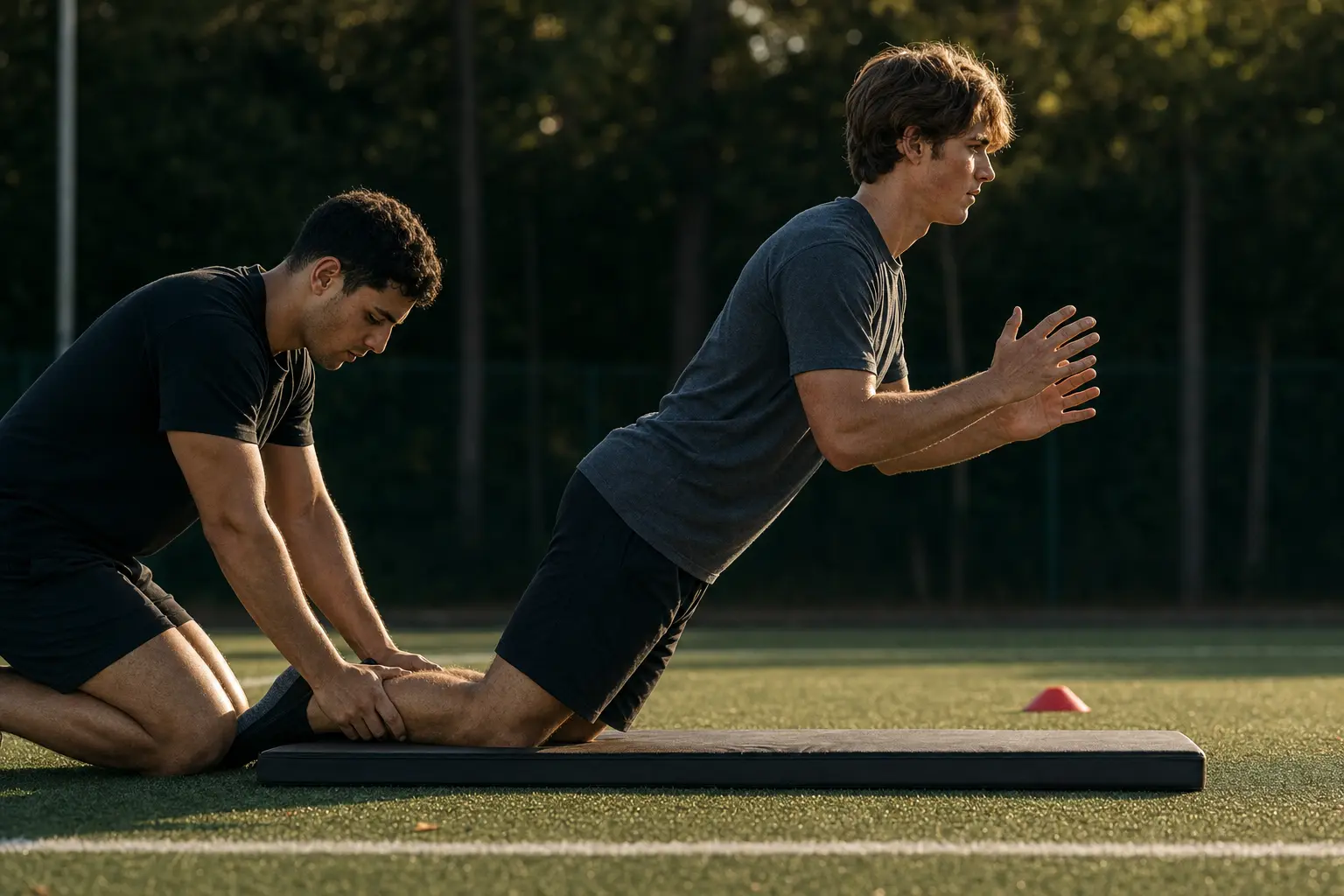
Kneel with your ankles held down and your body straight from knees to head, then lower yourself toward the floor as slowly as you can. Catch yourself with your hands when you can't hold on, and push back up. A 2019 review of 15 studies found that injury prevention programs that included Nordic curls cut hamstring injuries by about half. Beginners can start with 2 sets of 5 once a week.
- Anchor your ankles. Kneel on a pad or a folded mat. Have a partner hold your ankles down, or hook your heels under something heavy that won't move.
- Set your body. Kneel tall with your knees under your hips. Squeeze your glutes so your body is straight from your knees to your head, and hold your hands in front of your chest.
- Lower slowly. Lean forward from the knees, not the hips. Fight the fall with your hamstrings for as long as you can. Aim for a slow, steady lowering.
- Catch yourself. When you can't hold on any longer, let your hands take you to the floor like the bottom of a push-up.
- Return to the start. Push off the floor with your hands to get back to kneeling, using your hamstrings to help as much as you can. That's one rep.
What a Nordic hamstring curl is
A Nordic hamstring curl, also called a Nordic curl or the Nordic hamstring exercise, works the hamstrings on the back of your thighs. Instead of lifting a weight, you lower your own body toward the floor while your ankles are held down. Your hamstrings do the braking. Training a muscle while it lengthens like this is called eccentric training.
It needs no equipment besides something to hold your ankles, which is part of why sports teams use it.
What the research says
Nordic curls are one of the best-studied exercises for preventing injuries.
- About half the injuries. A 2019 review pooled 15 studies across different sports and age groups, in both women and men. Programs that included Nordic curls had about half the rate of hamstring injuries. Their analysis put the drop at up to 51%.
- A large soccer trial. In a 2011 trial, 50 Danish soccer teams were split into two groups. Teams that added a 10-week Nordic curl program, then kept doing them weekly, had 15 acute hamstring injuries over a season. The teams that trained as usual had 52.
- Low doses work. In a 2018 study, a group that did 2 sets of 4 once a week (after two weeks of building up) gained about as much eccentric strength as a group doing many more reps. A 2020 review of 13 studies agreed, and found that results showed up after programs of at least six weeks.
- Keep it going. In that 2018 study, the longer muscle fibers the training built went back to where they started within two weeks of stopping. Strength held for at least four weeks.
Common mistakes, and fixes
| Mistake | Try |
|---|---|
| Bending at the hips as you lower | Squeeze your glutes and think “straight line from knees to head” |
| Dropping straight to the floor | Lower only as far as you can control, then catch yourself early |
| Sore knees | Kneel on a thick pad or a folded mat |
| Very sore legs for days | Do fewer reps, and add more slowly from week to week |
Easier and harder versions
- Easier: band-assisted Nordic. Loop a resistance band around something high behind you and around your chest. The band holds some of your weight so you can lower slowly the whole way.
- Easier: shorter range. Put a box or a stack of cushions in front of you and lower onto it. Lower the target as you get stronger.
- Harder: slower lowers. Take longer to reach the floor, or pause partway down for a second or two.
- Harder: full Nordic. Lower all the way, then pull yourself back up with your hamstrings, with little or no push from your hands.
Sets and reps to start with
Start with 2 sets of 5 reps, once a week. That’s the first week of a 10-week plan that many studies have used or adapted, as listed in a 2020 review:
| Week | Sets and reps | Sessions a week |
|---|---|---|
| 1 | 2 sets of 5 | 1 |
| 2 | 2 sets of 6 | 2 |
| 3 | 3 sets of 6 to 8 | 3 |
| 4 | 3 sets of 8 to 10 | 3 |
| 5 to 10 | 3 sets of 12, then 10, then 8 | 3 |
You don’t have to climb that high. The 2018 study found that 2 sets of 4 once a week, after a two-week build-up of 4 sets of 6 twice a week, worked about as well as the bigger program.
Safety
If you’ve hurt a hamstring recently, check with a doctor or physical therapist before you start. Expect some soreness after the first few sessions; our guide to muscle soreness explains what’s normal. Stop if you feel a sharp pain in the back of your thigh or your knee.
Nordic curls pair well with hip hinges like the deadlift and the Jefferson curl, and with squats like the Zercher squat.
Also asked
Do Nordic curls prevent hamstring injuries?
They seem to help a lot. A 2019 review of 15 studies found that injury prevention programs that included Nordic curls had about half the hamstring injuries of programs without them. In one trial of 942 Danish soccer players, the group that added Nordic curls had 15 acute hamstring injuries in a season, against 52 in the group that didn't.
How many Nordic curls should I do?
Less than you might think. In a 2018 study, a group that did just 2 sets of 4 once a week (after two weeks of building up) gained about as much strength as a group doing far more. A 2020 review agreed that lower doses work, as long as you keep it up for at least six weeks.
Can I do Nordic curls at home?
Yes. Kneel on a cushion and hook your heels under a heavy sofa or a sturdy bed frame, or ask someone to hold your ankles. Make sure whatever holds your feet can't tip or slide.
Why are Nordic curls so hard?
You're holding up most of your body weight with your hamstrings while they lengthen. Most people drop fast near the bottom at first. That's normal. Lowering a little slower and a little farther over time is how you get better.
Will Nordic curls make me sore?
Often, at first. Hard lowering work tends to cause soreness, especially in the first sessions. Start with 2 sets of 5 and add reps slowly. A 2020 review noted that many teams don't stick with Nordic curls, and suggested heavy doses are part of the reason.
Sources
- van Dyk, Behan and Whiteley (2019), Including the Nordic hamstring exercise in injury prevention programmes halves the rate of hamstring injuries: a systematic review and meta-analysis of 8459 athletes
- Petersen et al. (2011), Preventive effect of eccentric training on acute hamstring injuries in men's soccer: a cluster-randomized controlled trial
- Presland et al. (2018), The effect of Nordic hamstring exercise training volume on biceps femoris long head architectural adaptation
- Cuthbert et al. (2020), The effect of Nordic hamstring exercise intervention volume on eccentric strength and muscle architecture adaptations: a systematic review and meta-analyses