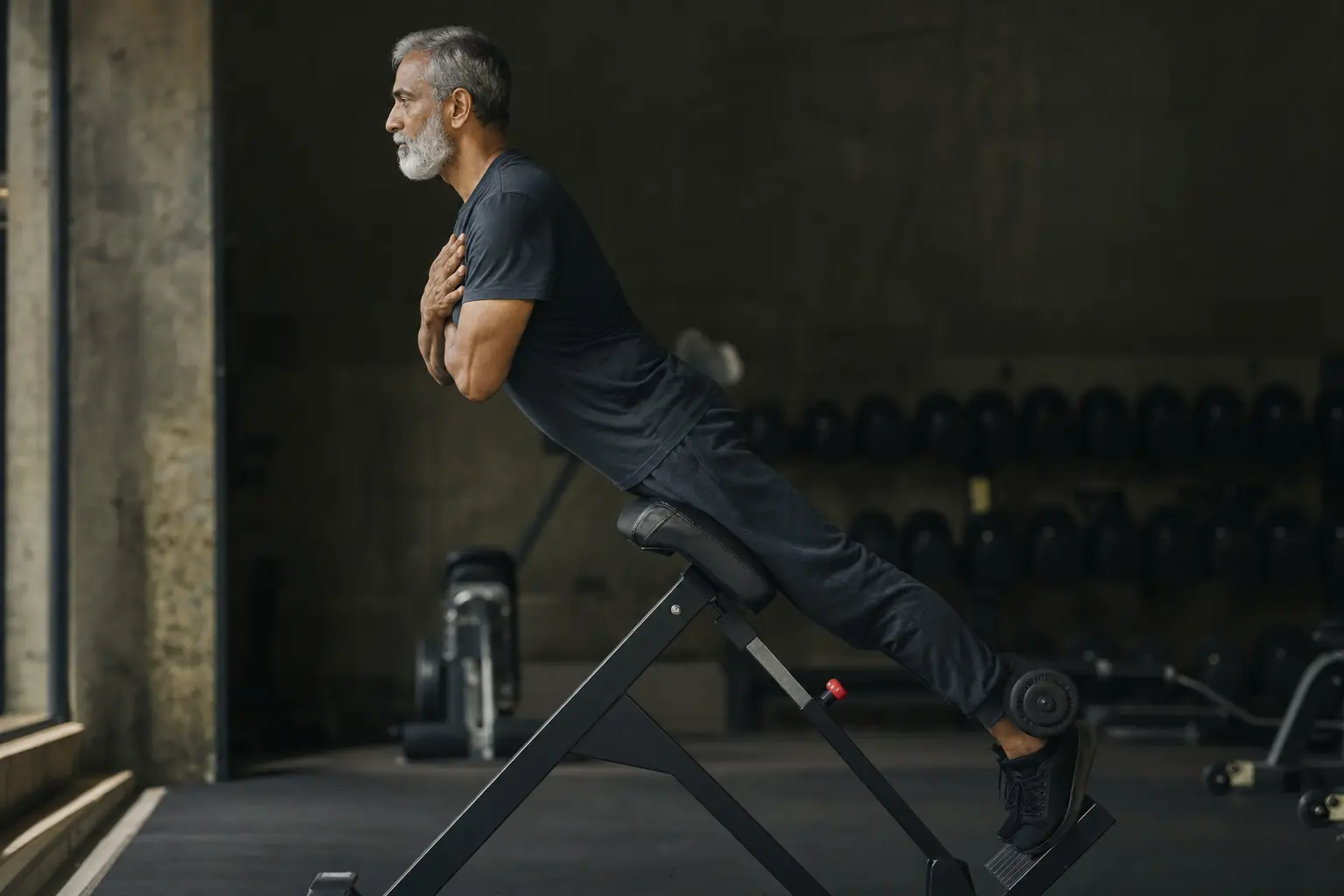
 AI-generated image
Guides · Strength training · Updated 2026-11-12
How do you do a back extension?
To do a back extension, set the pad of the back extension machine just below your hip bones and hook your heels under the rollers. Cross your arms, bend forward at the hips with a flat back, then squeeze your glutes to lift until your body is in a straight line. Stop there, without arching past it. The move trains your lower back along with your glutes and hamstrings, and body weight alone is enough to start.
- Set the pad. Adjust the pad so its top edge sits just below your hip bones. Your hips need room to fold over it.
- Lock your feet. Step onto the foot plate and hook the backs of your ankles under the rollers. Keep a soft bend in your knees.
- Get straight. Cross your arms over your chest. Brace your core so your body is one line from your head to your heels.
- Bend at the hips. Lower your chest slowly by folding at the hips, with your back flat. Go down until you feel a stretch in your hamstrings.
- Lift to a straight line. Squeeze your glutes and raise your chest until your body is straight again. Don't lean back past that point.
What a back extension is
A back extension is a hip hinge done on a bench that holds your legs still. You fold forward at the hips, then lift your upper body back to a straight line. Some gyms call it a hyperextension. That name oversells it, because a good rep stops when your body is straight.
It trains the muscles along the back of your body, from your hamstrings up to your lower back. Body weight is plenty at first, and you can hold a plate once that gets easy.
Which back extension machine is which?
“Back extension machine” can mean four different things in a gym.
| Equipment | What it looks like | Good to know |
|---|---|---|
| 45 degree back extension bench | An angled pad for your hips and rollers for your heels. Often called a Roman chair | The most common one, and the easiest to learn on |
| Flat back extension bench | The same idea, with your body level with the floor at the top | Feels harder near the top of each rep |
| Glute-ham bench | A rounded pad with a foot plate behind it | Can be used for flat back extensions too |
| Seated back extension machine | You sit and push back against a pad, with a weight stack | Works the lower back, with less from the glutes and hamstrings |
This guide covers the 45 degree back extension. The steps are the same on a flat bench.
What muscles do back extensions work?
A 2021 study of 15 trained women compared the 45 degree back extension with two other lifts: the seated back extension machine and the Romanian deadlift. Each lift was loaded to a weight they could lift 6 times. Here is how much more muscle activity the two hip hinges showed than the seated machine:
| Muscle | 45 degree back extension | Romanian deadlift |
|---|---|---|
| Glutes (gluteus maximus) | 140% more | 94% more |
| Hamstrings (biceps femoris) | 174% more | 61% more |
| Lower back (erector spinae) | No difference | No difference |
So the bench works your lower back as much as the seated machine does, and your glutes and hamstrings far more. The gap in glute activity between the bench and the Romanian deadlift was too small to count as a real difference. The authors called the 45 degree bench the best of the group for the lower body overall.
Back extensions for glutes: the glute extension
Many people use this bench mainly as a glute exercise and call it a glute extension. The usual cues are:
- Set the pad a little lower, so your hips are free to move.
- Turn your feet out slightly.
- Keep your upper back gently rounded and your chin tucked.
- Push your hips into the pad and squeeze your glutes to come up.
We found no study that tests these cues against the standard form, so treat them as feel, not fact. In the study above, the lifters kept a straight back and their glutes still worked hard. Try both ways with body weight and keep the one where you feel your glutes do the lifting.
Where should your hands go?
Crossed over your chest is the easiest place. In a study of 18 male athletes on a Roman chair, putting the hands behind the head made an upper back muscle, the lower trapezius, work harder than crossing the arms did. If you put your hands by your head, keep them light. Don’t pull on your neck.
To add weight, hug a plate to your chest. The lifters in the 2021 study held plates at the chest and wore a weighted vest.
Easier and harder versions
- Easier: half reps. Lower only part of the way, then come back to straight.
- Easier: a standing hip hinge. Stand with a soft bend in your knees and push your hips back with a flat back.
- Harder: hold a plate. Hug it to your chest and keep your elbows in.
- Harder: pause at the top. Hold the straight line for a second on every rep.
Sets and reps
Start with 2 or 3 sets of 8 to 12 reps, two days a week. The ACSM’s 2009 guide gives beginners 8 to 12 reps, and its 2026 position stand advises at least two sets per exercise and training at least twice a week.
The 2009 guide also suggests doing lifts that use several joints before lifts that use one. The back extension moves mainly at the hips, so do it after your squats or deadlifts. When you can do one or two reps more than your target, add 2 to 10%. That is progressive overload.
Common mistakes, and fixes
| Mistake | Try |
|---|---|
| You lean back past straight at the top | Stop when your body is in one line and squeeze your glutes there |
| The pad is too high, so your back bends in place of your hips | Lower the pad to just below your hip bones |
| You swing up quickly | Lower slowly and pause for a moment at the bottom |
| Your hands pull on your neck | Cross your arms over your chest |
| You add weight too soon | Get 12 smooth body weight reps first |
Back extension alternatives
No bench free, or none at your gym? These train the same muscles.
| Alternative | What you need | Why it works |
|---|---|---|
| Romanian deadlift | A barbell or dumbbells | The same hip hinge, done standing. It showed similar glute activity in the study above |
| Single-leg RDL | One dumbbell or none | The hinge on one leg, with light weight |
| Hip thrust | A bench and a weight | Loads your glutes with your back supported |
| Glute bridge | A mat | The no-equipment option |
For the whole list, see the best glute exercises. To put them into a week, see a good glute workout.
Safety
Adjust the pad and check that the foot rollers are locked before you climb on. Move slowly with a flat back, and stop at a straight line. Stop if you feel sharp pain anywhere.
This guide is about training, not about back pain. If your back hurts or you have a back condition, ask a doctor or physical therapist before you do back extensions.
Also asked
What muscles do back extensions work?
Your lower back shares the work with your glutes and hamstrings. In a study of 15 trained women, the 45 degree back extension showed 140% more glute activity and 174% more hamstring activity than a seated back extension machine. Lower back activity was the same on both.
Are back extensions good for glutes?
Yes. In the same study, glute activity on the 45 degree bench was about as high as in the Romanian deadlift. Squeeze your glutes to lift, and stop when your body is straight.
What is a glute extension?
It's a back extension done with the glutes in mind, also called a glute focused back extension. People set the pad a little lower and turn their feet out slightly. Many also keep the upper back gently rounded. We found no study that tests these cues against the standard form.
What is a 45 degree back extension?
It's a back extension on a bench that holds your body at a 45 degree angle, often called a Roman chair. It's the most common back extension bench in gyms and the easiest one to learn on.
Is the seated back extension machine the same exercise?
Not quite. You sit and push back against a pad. In a study of 15 trained women, it worked the lower back as much as the 45 degree bench, with much less activity in the glutes and hamstrings.
What is a good back extension alternative?
The Romanian deadlift is the closest. It's the same hip hinge done standing, with a barbell or dumbbells. Glute bridges and hip thrusts also train your glutes with no back extension bench.
How do I make back extensions harder?
Hold a weight plate against your chest. Start light, and add 2 to 10% once you can do one or two reps more than your target, as the American College of Sports Medicine suggests.
Should I do back extensions if my back hurts?
This guide is about training, not about back pain. If your back hurts or you have a back condition, ask a doctor or physical therapist before you do them.
Sources
- Andersen et al. (2021), Comparison of Muscle Activity in Three Single-Joint, Hip Extension Exercises in Resistance-Trained Women
- Park and Yoo (2014), Effects of hand and knee positions on muscular activity during trunk extension exercise with the Roman chair
- Currier et al. (2026), American College of Sports Medicine position stand: Resistance training prescription for muscle function, hypertrophy, and physical performance in healthy adults
- American College of Sports Medicine (2009), Progression models in resistance training for healthy adults