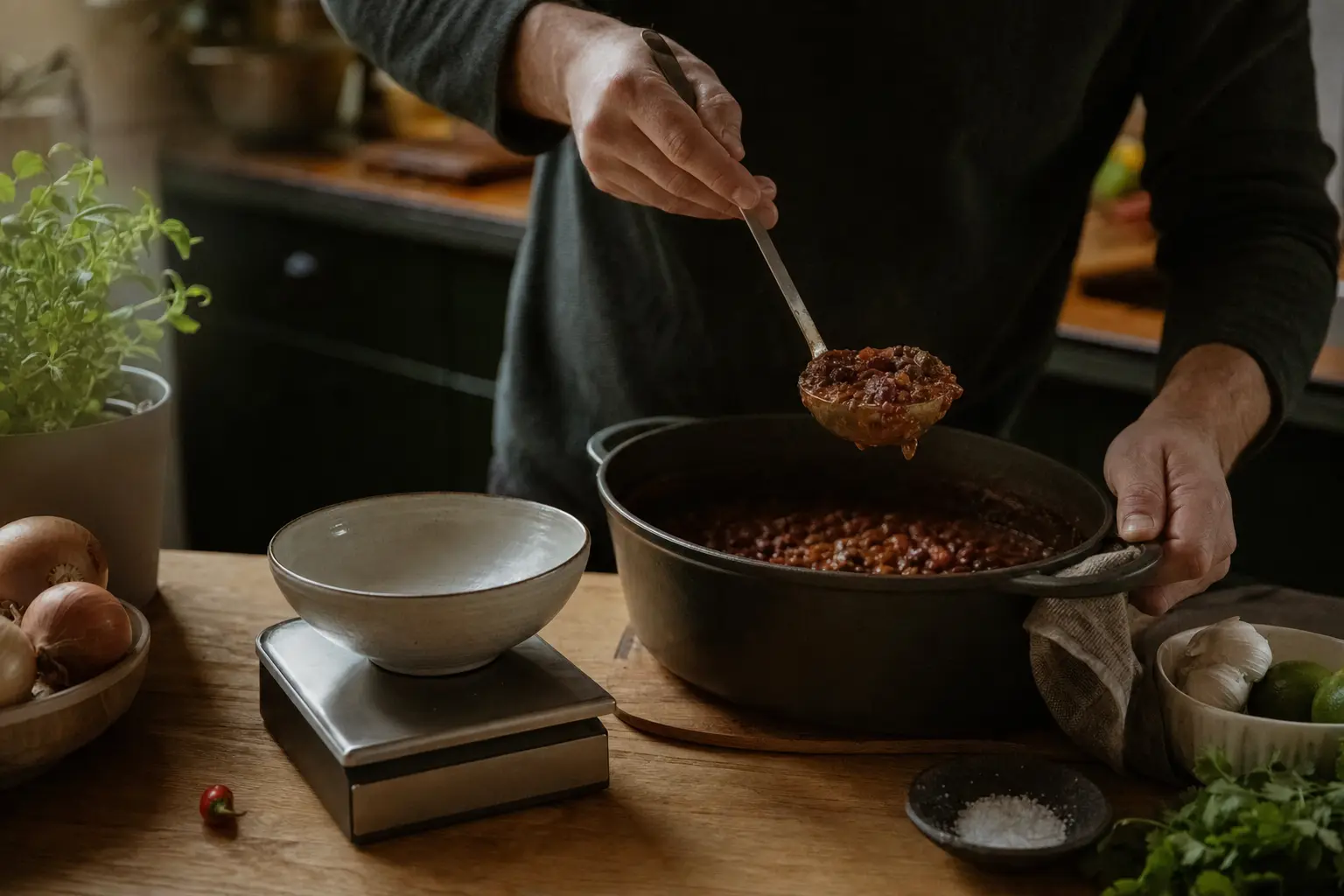
 AI-generated image
Guides · Food and nutrition · Updated 2026-11-01
How do I calculate calories in homemade food?
Add up the calories of every ingredient, using the label or USDA FoodData Central, then divide by how much of the dish you eat. The closest way is to weigh the finished dish and work out the calories per 100 grams. Then weigh your portion. If you don't weigh it, split the total by the number of servings and log one share.
- List every ingredient. Write down everything that goes in, including the oil in the pan and any butter or cheese added at the end.
- Weigh or measure each one raw. Use grams if you have a scale. Cups and spoons work too. For canned beans, weigh them after draining.
- Look up each ingredient. Use the nutrition label for packaged foods. For fresh foods, look up the raw version in USDA FoodData Central.
- Add up the total. Multiply each food's calories per 100 grams by its weight, then add the results for the whole pot.
- Weigh the finished dish. Weigh the empty pot first, or set the scale to zero with the pot on it. Then weigh the pot of food and take off the pot's weight.
- Work out your portion. Divide the total calories by the finished weight to get calories per 100 grams, then weigh your bowl. No scale? Divide by the number of servings.
The basic method
Every homemade dish works the same way. Find the calories in each ingredient, add them up, then work out what share of the dish you ate. The only hard part is the last step, because a pot of chili doesn’t come with a serving size.
You have two choices:
- Weigh the finished dish. This is the closest. You get calories per 100 grams, and any bowl you weigh is easy to count.
- Split it into servings. No scale needed. Divide the total by the number of even servings and log one.
A worked example: turkey chili
Here’s a simple pot of chili, with numbers from USDA FoodData Central. All weights are before cooking, and the beans are weighed after draining.
| Ingredient | Amount | Calories | Protein (g) | Carbs (g) | Fat (g) |
|---|---|---|---|---|---|
| Olive oil | 1 tablespoon (13.5 g) | 119 | 0 | 0 | 13.5 |
| Onion, raw | 1 medium (110 g) | 44 | 1.2 | 10.3 | 0.1 |
| Ground turkey, 93% lean, raw | 1 pound (453 g) | 680 | 84.7 | 0 | 37.8 |
| Kidney beans, canned, drained | 2 cans (532 g) | 660 | 42.5 | 114.4 | 5.6 |
| Canned tomatoes in juice | 28-ounce can (794 g) | 127 | 6.3 | 27.6 | 2.0 |
| Whole pot | 1,902 g of ingredients | 1,630 | 134.7 | 152.3 | 59.0 |
Each row is the USDA value per 100 grams times the weight. For the turkey, that’s 150 calories per 100 grams times 4.53, which is about 680.
Now weigh the finished chili. Cooking drives off water, so the pot will weigh less than what went in. Say it weighs 1,750 grams once it’s done.
- Calories per 100 grams: 1,630 divided by 17.5 is about 93.
- A 350 gram bowl: 3.5 times 93 is about 326 calories, with about 27 grams of protein.
Or split it four ways. A quarter of the pot is about 407 calories and 34 grams of protein. That’s fine if you really do split it evenly. If you serve yourself by eye, weighing is closer.
Spices and garlic barely move the total, so you can leave them out. Oil, butter, cheese and sour cream are a different story: they add up fast, so count them.
Raw or cooked weights?
Weigh and look up ingredients raw. Cooking changes the weight of food through water and fat loss, which is what USDA’s cooking yield tables measure.
Ground turkey shows how much it matters. USDA lists raw 93 percent lean ground turkey at 150 calories per 100 grams, and cooked crumbles at 213. If you weigh cooked meat but use the raw entry, you undercount by about 30 percent. Either pair is fine, as long as the weight and the entry match.
The same idea applies to rice and pasta. They soak up water as they cook, so a cooked weight with a dry entry will overcount. Check whether the entry you pick is for the dry food or the cooked one.
Where to find the numbers
- Nutrition labels for anything packaged. Check the serving size first, because every number on the label is for one serving. Our guide to reading a nutrition label walks through it.
- USDA FoodData Central for fresh foods like meat, vegetables, fruit and grains. It’s free, and it lists calories and macros per 100 grams, along with common portions like “1 medium onion”.
Pick one entry for each food and stick with it, so your counts stay the same from week to week.
If you don’t have a scale
You can still get close. Measure the ingredients with cups and spoons, add them up, then split the dish into even servings. Our guide to counting calories without a food scale has more ways to estimate portions by eye.
If you cook in batches, split the pot into containers as you pack it. Then each container is one serving, and you don’t have to guess later. Our guide to meal prep covers batch cooking.
Logging it
Once you know the totals, save them so you don’t redo the math. Next time, you only need to log how much you ate.
If you log by talking to an AI assistant, tell it the ingredients and how much you had, such as “a third of the pot”. Our guide to logging food by talking to AI shows how. For protein, carbs and fat targets, see how to track macros.
Your count won’t be perfect, and it doesn’t have to be. If you count the same way each time, your weekly weight trend tells you whether to eat a little more or a little less.
Also asked
Should I use raw or cooked weights for a recipe?
Use raw weights for the ingredients and raw entries to match. Cooking changes weight, mostly through water and fat loss, so a cooked weight with a raw entry gives the wrong answer. USDA lists raw 93 percent lean ground turkey at 150 calories per 100 grams and pan-broiled crumbles at 213, because the cooked meat has lost water.
How do I count calories in soup or stew?
Add up the ingredients, including the stock, then weigh the finished pot. Divide the total calories by the weight to get calories per 100 grams, and weigh or measure your bowl. If the pot is too heavy for your scale, count how many even ladles or bowls it makes and divide by that.
Does cooking change the calories in food?
Cooking mostly changes the weight, not the total. Water cooks off, so the food weighs less and each gram has more calories. That's why you weigh the dish after cooking if you want calories per gram. If you pour off fat from ground meat, the true total is a little lower than your count.
How do I count calories in a recipe without a scale?
Add up the ingredients using measuring cups and labels, then split the dish into even servings and log one. It's less exact than weighing, but if you do it the same way each time, your weight trend tells you whether to eat more or less.
What about a meal I make often?
Work out the totals once and save them. Next time, you only need to say how much you ate. If you change the recipe, such as more oil or a fattier cut of meat, redo the math.
Sources
- US Department of Agriculture, FoodData Central, SR Legacy entries used in the worked example (olive oil 171413; onions, raw 170000; turkey, ground, 93% lean, raw 172850 and pan-broiled crumbles 172851; kidney beans, canned, drained 174285; tomatoes, canned in tomato juice 170051)
- US Department of Agriculture, Agricultural Research Service (2014), USDA Table of Cooking Yields for Meat and Poultry, Release 2
- US Food and Drug Administration, How to understand and use the Nutrition Facts label