 AI-generated image
Guides · Strength training · Updated 2026-11-11
What is a good full body dumbbell workout plan?
A simple dumbbell workout plan is two full body workouts, A and B, done 3 days a week with a rest day between. Each one has six moves that cover your legs, chest, back and shoulders, for 2 or 3 sets of 8 to 12 reps. Stop each set with a rep or two left. Add reps each week, and when you can do 12 good reps on every set, move to heavier dumbbells.
- Warm up for 5 minutes. March on the spot and circle your arms. Then do one light set of the first move.
- Do workout A or B. Finish all the sets of one move before the next. Rest 1 to 2 minutes between sets.
- Stop with a rep or two left. End each set while your form still looks the same as the first rep.
- Write down what you lifted. Note the weight of one dumbbell and the reps for each set, so next time you know what to beat.
Your week
| Day | Week 1 | Week 2 |
|---|---|---|
| Monday | Workout A | Workout B |
| Wednesday | Workout B | Workout A |
| Friday | Workout A | Workout B |
Any three days work, as long as there’s a rest day between them. Only have two days? Do A on one and B on the other. For beginners, the American College of Sports Medicine suggests 8 to 12 reps a set, on 2 or 3 days a week.
Workout A
| Exercise | Sets and reps | Works |
|---|---|---|
| Goblet squat | 3 sets of 8 to 12 | Thighs and glutes |
| Dumbbell bench press or floor press | 3 sets of 8 to 12 | Chest and triceps |
| One-arm dumbbell row | 3 sets of 8 to 12 each arm | Upper back and biceps |
| Dumbbell Romanian deadlift | 3 sets of 8 to 12 | Hamstrings and glutes |
| Overhead press | 2 sets of 8 to 12 | Shoulders and triceps |
| Plank | 2 holds of 20 to 30 seconds | Core |
Workout B
| Exercise | Sets and reps | Works |
|---|---|---|
| Reverse lunge | 3 sets of 8 to 12 each leg | Thighs and glutes |
| Incline dumbbell press | 3 sets of 8 to 12 | Upper chest and shoulders |
| Bent-over row, both arms | 3 sets of 8 to 12 | Upper back and biceps |
| Dumbbell glute bridge | 3 sets of 10 to 15 | Glutes and hamstrings |
| Lateral raise | 2 sets of 10 to 15 | Sides of the shoulders |
| Farmers carry | 2 walks of about 30 seconds | Grip and core |
Rest 1 to 2 minutes between sets. Stop each set with 1 or 2 good reps left. Researchers call that reps in reserve, and it’s an easy way to judge effort (see the RPE scale).
How to do each move
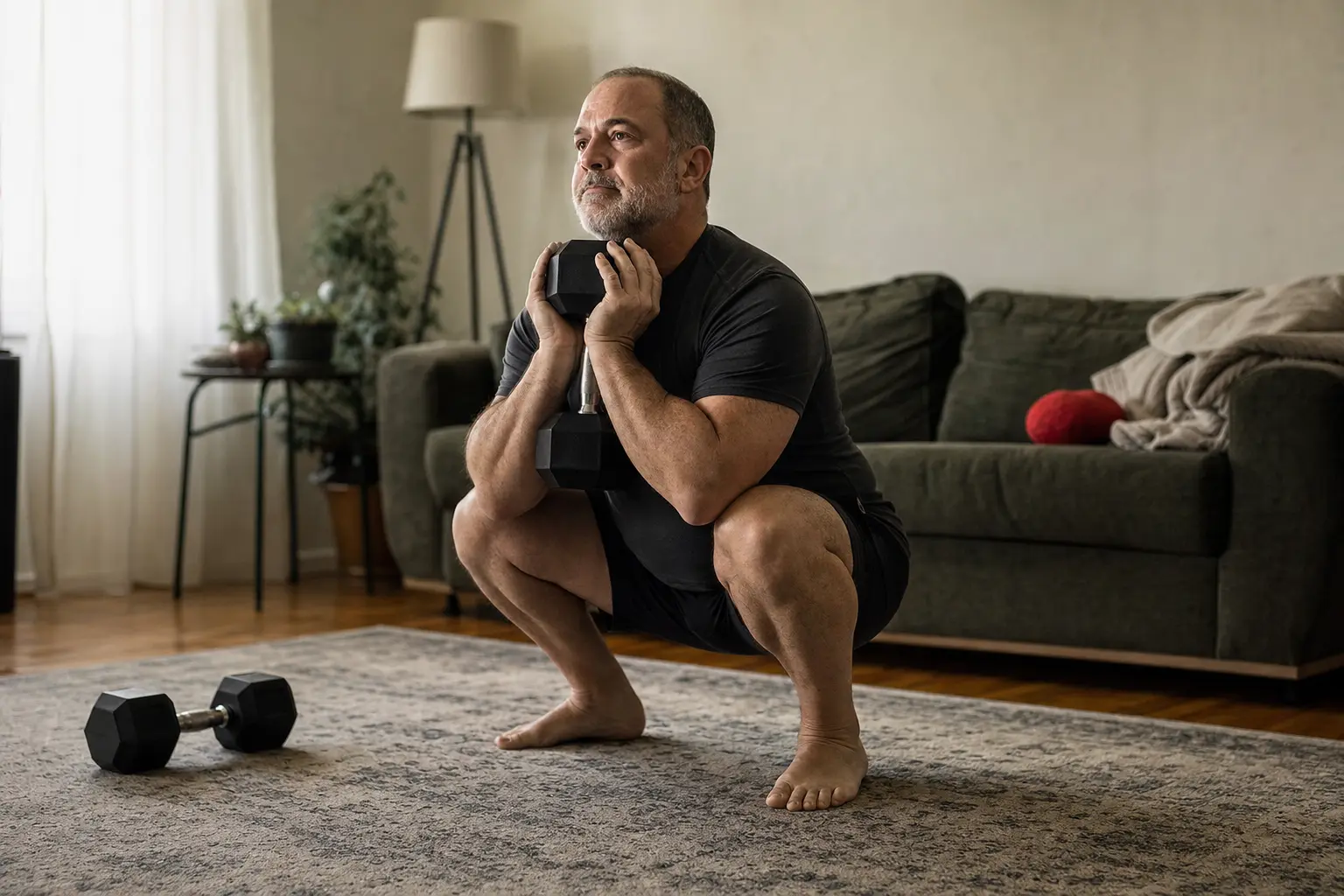
Goblet squat. Hold one dumbbell upright against your chest. Keep your chest up as you sit down between your heels, then stand. See how to squat.
Bench press or floor press. Lie on a bench, or on the floor with knees bent. Press both dumbbells up over your chest, then lower until your elbows are a little below your body (or touch the floor).
One-arm row. Put one hand and knee on a bench or a sturdy chair. Pull the dumbbell up toward your hip, then lower it all the way.
Romanian deadlift. Hold the dumbbells in front of your thighs. Push your hips back with a soft bend in your knees and slide the weights down your legs until you feel a stretch, then stand tall.
Overhead press. Hold the dumbbells at your shoulders, palms forward or facing in. Press them straight up, then lower slowly. Sitting makes it steadier.
Plank. Rest on your forearms and toes with your body in one straight line. See how long to hold a plank.
Reverse lunge. Hold a dumbbell in each hand. Step one foot back, lower until both knees are bent, then push through the front foot to stand.
Incline press. Set a bench at a low incline, or prop your back on a firm cushion on the floor. Press the dumbbells up over your upper chest.
Bent-over row. Hinge forward with a flat back and the dumbbells hanging. Pull both up toward your ribs, then lower.
Glute bridge. Lie on your back with knees bent and a dumbbell across your hips. Push through your heels to lift your hips, then lower.
Lateral raise. Stand with light dumbbells at your sides. Lift them out to shoulder height with a slight bend in your elbows, then lower slowly.
Farmers carry. Pick up heavy dumbbells and walk tall with short steps.
Easier and harder versions
| Exercise | Easier | Harder |
|---|---|---|
| Goblet squat | Squat down to a chair | Pause for two seconds at the bottom |
| Bench press | Floor press, which stops at the floor | Lower over three seconds |
| One-arm row | Lighter dumbbell, more reps | Pause with the dumbbell at your hip |
| Romanian deadlift | Shorter range, only to your knees | One leg at a time |
| Reverse lunge | Hold a wall instead of dumbbells | Back foot on a bench (split squat) |
| Overhead press | Seated, one arm at a time | Standing, both arms together |
How heavy should your dumbbells be?
Pick a weight you can lift for 10 clean reps with 2 or 3 more left. Your legs and back will take heavier dumbbells than your shoulders and arms, so expect two or three different pairs if you can get them. The full method, with starting points for each lift, is in how much weight should I lift.
When you write it down, log the weight of one dumbbell. A pair of 25s is 25 lb.
How to progress
Use a rep range. Start near the bottom of 8 to 12. Each session, try to add a rep to a set or two. When every set reaches 12 with good form, go to the next dumbbell up and start again near 8. The ACSM suggests adding 2 to 10% of the load once you can do one or two reps more than your target, two sessions in a row.
Dumbbell jumps can be big, since 15 to 20 lb is a third heavier. So lean on reps first. You can also slow the lowering or try a one-leg or one-arm version. This is progressive overload.
If you only have one pair
Pick a pair that’s right for your shoulders, then make the other moves harder in other ways. Do split squats instead of goblet squats. Do the Romanian deadlift on one leg. Hold a pause at the hardest point. Once 15 or more reps feel easy, it’s time for a heavier pair.
Want to focus on one area?
No dumbbells yet? Start with the full body workout without equipment.
Also asked
Can you build muscle with just dumbbells?
Yes. Muscle responds to hard sets, not to the kind of weight. A 2017 review of 21 studies found that light and heavy loads built similar muscle when sets were taken close to failure. Dumbbells let you do both.
How many days a week should I do a dumbbell workout?
Three full body days is a good start. A 2016 review found that training each muscle twice a week built more muscle than once a week. Two days still works, and the NHS suggests strength work on at least 2 days a week.
What dumbbells should I buy for home?
If you can only buy one pair, pick one you can press overhead about 10 times. Your legs will soon want heavier, so a second, heavier pair or an adjustable set helps after the first few months.
How long does the workout take?
About 40 to 50 minutes with a warm-up and full rest. For a 30 minute version, do 2 sets of each move instead of 3.
Should I do workout A and B on the same week?
Yes. Alternate them: A, B, A one week, then B, A, B the next. Each move comes up three times every two weeks.
Do I count one dumbbell or both?
Log the weight of one dumbbell. A pair of 20 lb dumbbells is written as 20 lb. That keeps your numbers easy to compare from week to week.
Is this enough cardio?
It's strength work. Health guidelines also call for 150 minutes of moderate activity a week, such as brisk walking.
Sources
- American College of Sports Medicine (2009), Progression models in resistance training for healthy adults (position stand)
- Schoenfeld et al. (2016), Effects of resistance training frequency on measures of muscle hypertrophy, a systematic review and meta-analysis
- Schoenfeld et al. (2017), Strength and hypertrophy adaptations between low- vs. high-load resistance training, a systematic review and meta-analysis
- Zourdos et al. (2016), Novel resistance training-specific rating of perceived exertion scale measuring repetitions in reserve
- NHS, Physical activity guidelines for adults aged 19 to 64