 AI-generated image
Guides · Strength training · Updated 2026-11-13
How do you do a sumo squat?
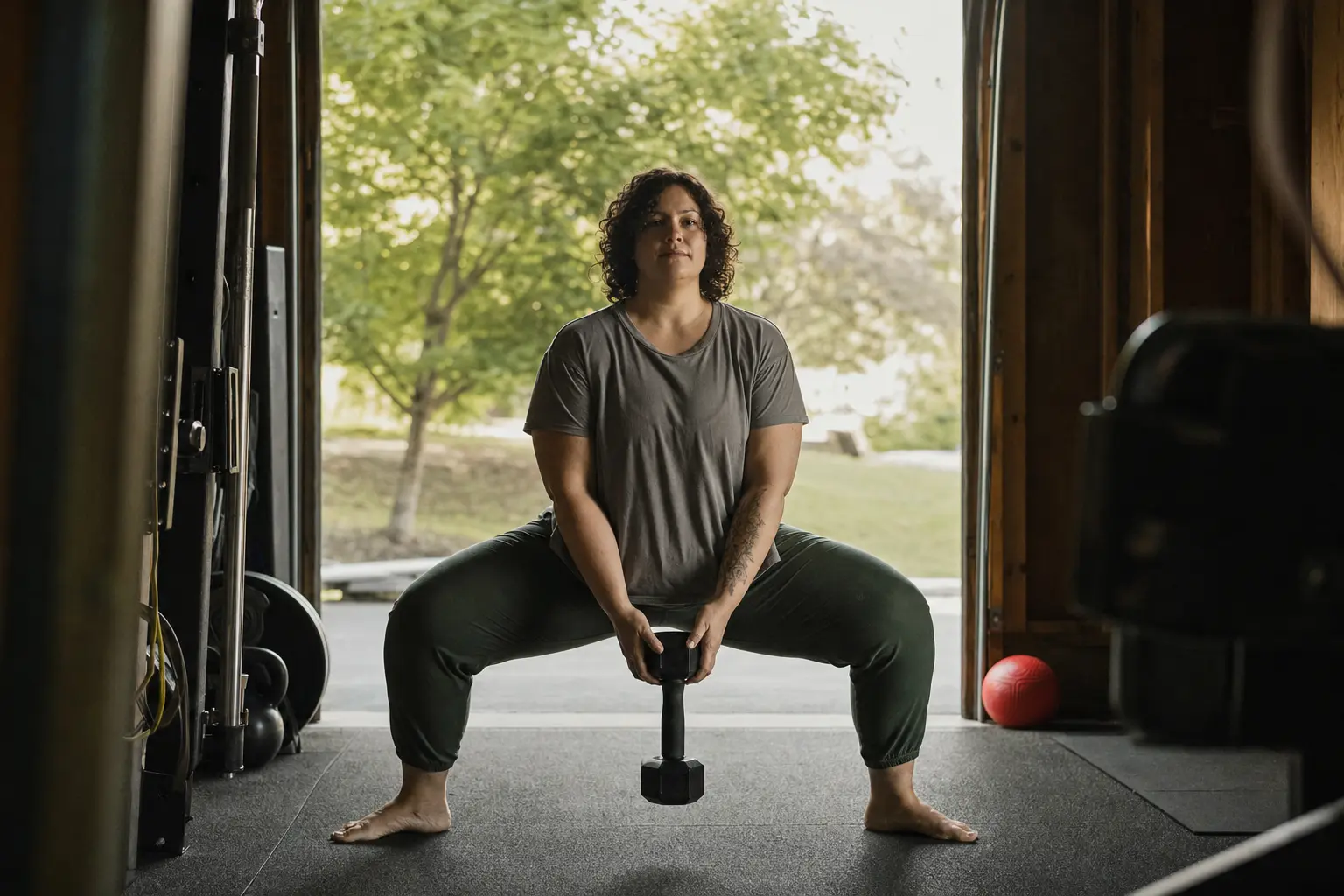
To do a sumo squat, stand with your feet wider than your shoulders and your toes turned out. Hold one dumbbell or kettlebell with both hands, hanging in front of your hips or held at your chest. Sit straight down with your knees pushed out over your toes and your chest up, then stand by pushing through your whole foot. Start with no weight until the wide stance feels steady.
- Set a wide stance. Stand with your feet wider than your shoulders. Turn your toes out a little more than you would for a regular squat.
- Hold the weight. Hold one dumbbell by its top end with both hands and let it hang between your legs, or hold it against your chest.
- Brace and sit down. Breathe into your belly and tighten your core. Sit straight down between your feet and push your knees out in line with your toes.
- Find your depth. Go as low as you can with your heels down and your back flat. For many people that's thighs level with the floor or a little below.
- Stand up. Push the floor away through your whole foot. Keep your knees out and stand tall without leaning back.
What a sumo squat is
A sumo squat is a squat with a wide stance and your toes turned out. It’s also called a wide squat or a wide stance squat. Most people do it holding one dumbbell or kettlebell, and it also works with no weight at all.
Everything else is the same as in a regular squat. Your heels stay down and your back stays flat. Your knees follow your toes. If you’re new to squatting, read how to squat first.
Sumo squat form: a quick check
| Body part | What to aim for |
|---|---|
| Feet | Wider than your shoulders, with your toes turned out |
| Knees | Pushed out so they follow the line of your toes |
| Hips | Sit straight down between your feet |
| Back | Flat and braced, with your chest up |
| Depth | As low as you can go while your heels stay down and your back stays flat |
How wide is wide? In one study, the wide stance was 1.4 times shoulder width. At a national powerlifting meet, the widest group of squatters stood at about 1.7 times shoulder width. You don’t need to go that far. Pick a width where your knees can still follow your toes at the bottom.
What muscles do sumo squats work?
| Muscle | What it does |
|---|---|
| Front of the thighs (quads) | Straighten your knees as you stand |
| Glutes | Push your hips up out of the bottom |
| Inner thighs (adductors) | Help your glutes at the hip and steady your knees |
| Core and back | Hold your upper body upright |
The studies below used a barbell on the back with a wide stance, not a dumbbell. The stance is the same, so they are the best guide there is.
In a study of ten competitive bodybuilders, a wide stance raised the activity of an inner thigh muscle and an outer thigh muscle on the way up, compared with a regular stance. In a study of nine male lifters, the front thigh muscles worked the same at every width. Stance width did change how the inner thigh and the glutes worked.
Sumo squat vs regular squat
| Sumo squat | Regular squat | |
|---|---|---|
| Stance | Wider than your shoulders | About shoulder width |
| Toes | Turned out more | Turned out slightly |
| Shins | More upright | Lean forward more |
| Front of the thighs | About the same work | About the same work |
| Glutes and inner thighs | A little more work in some studies | A little less in some studies |
The shin row comes from a study of 39 lifters at a powerlifting meet. With a wide stance, their shins were 5 to 9 degrees more upright than with a narrow one. How far their upper bodies leaned was about the same.
Neither stance is better. A 2021 study of 18 lifters found that a wide stance with the bar low on the back put more of the work on the hips. A narrow stance with the bar high put more on the knees. Use the one that feels good on your hips, or do both on different days.
Sumo squats for glutes
Sumo squats train your glutes, and a wide stance may add a little. In a study of six experienced lifters who tried several stance widths, glute activity was higher at the widest one. None of the other muscles measured changed.
Depth and effort count for more than foot position. In a 10-week study, men who did full squats grew their glutes about 6.7%. Men who did half squats grew them about 2.2%. So go as deep as you can with good form, and add weight over time.
Squats alone leave some gaps. Pair them with a hinge such as the Romanian deadlift and a lift such as the hip thrust. The best glute exercises lists more, and how to grow your glutes covers training and eating.
What about the inner thighs?
Every squat works your inner thigh muscles, and a wide stance may ask a little more of them. It isn’t the most direct way to train them, though. In a study of 24 active students, the sumo squat showed the least inner thigh muscle activity of six exercises. Lying on your side and lifting the lower leg showed the most.
Working a muscle makes it stronger. It doesn’t choose where your body stores fat, and no exercise can.
Dumbbell sumo squat and other versions
| Version | How to hold the weight | Good to know |
|---|---|---|
| Body weight sumo squat | Hands together in front of your chest | Where to start |
| Dumbbell sumo squat | Both hands on the top end, dumbbell hanging between your legs | The dumbbell stops you when it reaches the floor |
| Goblet sumo squat | One dumbbell or kettlebell held at your chest | Helps you stay upright |
| Kettlebell sumo squat | Both hands on the handle, arms long | Easy to grip |
For a sumo squat with a dumbbell, stand the dumbbell on its end between your feet. Squat down and grip the top with both hands. Then stand up with your arms long. When that gets easy, move to the next dumbbell.
When one dumbbell is too light, slow down. Lower for three seconds, or pause for two seconds at the bottom. For a bigger step up, try the Bulgarian split squat, which puts the load on one leg.
Sets and reps to start with
Start with 2 or 3 sets of 8 to 12 reps, two days a week. A 2026 position stand from the American College of Sports Medicine (ACSM) found that strength improved with 2 to 3 sets and at least two sessions a week. The ACSM’s 2009 guide suggests that beginners use weights they can lift for 8 to 12 reps.
Rest 1 to 2 minutes between sets. When you can do one or two reps more than your target, the 2009 guide suggests adding 2 to 10%. See progressive overload and how many sets and reps build muscle. For a full session, see the glute workout.
Common mistakes, and fixes
| Mistake | Try |
|---|---|
| Your knees cave inward | Push them out over your toes. Narrow your stance a little if you can’t |
| Your heels lift | Bring your feet in slightly and sit straight down, not forward |
| Your chest drops toward the floor | Hold the weight at your chest and use less of it |
| Your stance is so wide that your hips pinch | Step in. Wider is not better |
Safety
Warm up with a set or two with no weight (see how to warm up before lifting). Keep a firm grip on the dumbbell and don’t swing it. Stand on a floor that isn’t slippery, because a wide stance can slide. If you feel sharp pain in your hips or your knees, stop. See a doctor or a physical therapist before you do the lift again.
Also asked
What muscles do sumo squats work?
The front of your thighs and your glutes do most of the work. Your inner thighs help, and your core holds you upright. In a study of ten competitive bodybuilders, a wide squat stance raised inner thigh and outer thigh muscle activity on the way up, compared with a regular stance.
Are sumo squats good for glutes?
Yes, like any deep squat. In a study of six experienced lifters, glute activity was higher at the widest of the stances tested. The other muscles measured didn't change. Depth matters too. In a 10-week study, full squats grew the glutes about 6.7%, against about 2.2% for half squats.
What is the difference between a sumo squat and a regular squat?
The stance. A sumo squat uses feet set wider than the shoulders with the toes turned out more. In studies of wide stances, the front thigh muscles worked about the same. The glutes did a little more in some of them.
Is a wide squat the same as a sumo squat?
Yes. Wide squat and wide stance squat are other names for the sumo squat. All of them mean a squat with your feet set wider than your shoulders and your toes turned out.
How wide should my feet be for a sumo squat?
Wider than your shoulders, at a width where your knees can still follow your toes. In studies, a wide squat stance has meant about 1.4 to 1.7 times shoulder width. Start at the narrow end of that range.
How do I do a dumbbell sumo squat?
Stand one dumbbell on its end and grip the top with both hands. Stand up with it hanging between your legs, arms long. Squat until the dumbbell is close to the floor, then stand. You can also hold it at your chest.
Is a sumo squat the same as a goblet squat?
No. Goblet describes how you hold the weight, which is at your chest. Sumo describes the wide stance. You can do both at once by holding a dumbbell at your chest in a wide stance.
Do sumo squats work the inner thighs?
Yes. Every squat works them, and a wide stance may add a little. They aren't the most direct inner thigh exercise, though. In a study of 24 active students, the sumo squat showed the least inner thigh muscle activity of six exercises, and lying on your side to lift the lower leg showed the most.
Sources
- Paoli et al. (2009), The effect of stance width on the electromyographical activity of eight superficial thigh muscles during back squat with different bar loads
- McCaw and Melrose (1999), Stance width and bar load effects on leg muscle activity during the parallel squat
- Escamilla et al. (2001), A three-dimensional biomechanical analysis of the squat during varying stance widths
- Coratella et al. (2021), The Activation of Gluteal, Thigh, and Lower Back Muscles in Different Squat Variations Performed by Competitive Bodybuilders: Implications for Resistance Training
- Larsen et al. (2021), Effects of Stance Width and Barbell Placement on Kinematics, Kinetics, and Myoelectric Activity in Back Squats
- Delmore et al. (2014), Adductor longus activation during common hip exercises
- Kubo et al. (2019), Effects of squat training with different depths on lower limb muscle volumes
- Currier et al. (2026), American College of Sports Medicine Position Stand. Resistance Training Prescription for Muscle Function, Hypertrophy, and Physical Performance in Healthy Adults: An Overview of Reviews
- American College of Sports Medicine (2009), Progression models in resistance training for healthy adults