 AI-generated image
Guides · Strength training · Updated 2026-11-12
How do you do glute kickbacks?
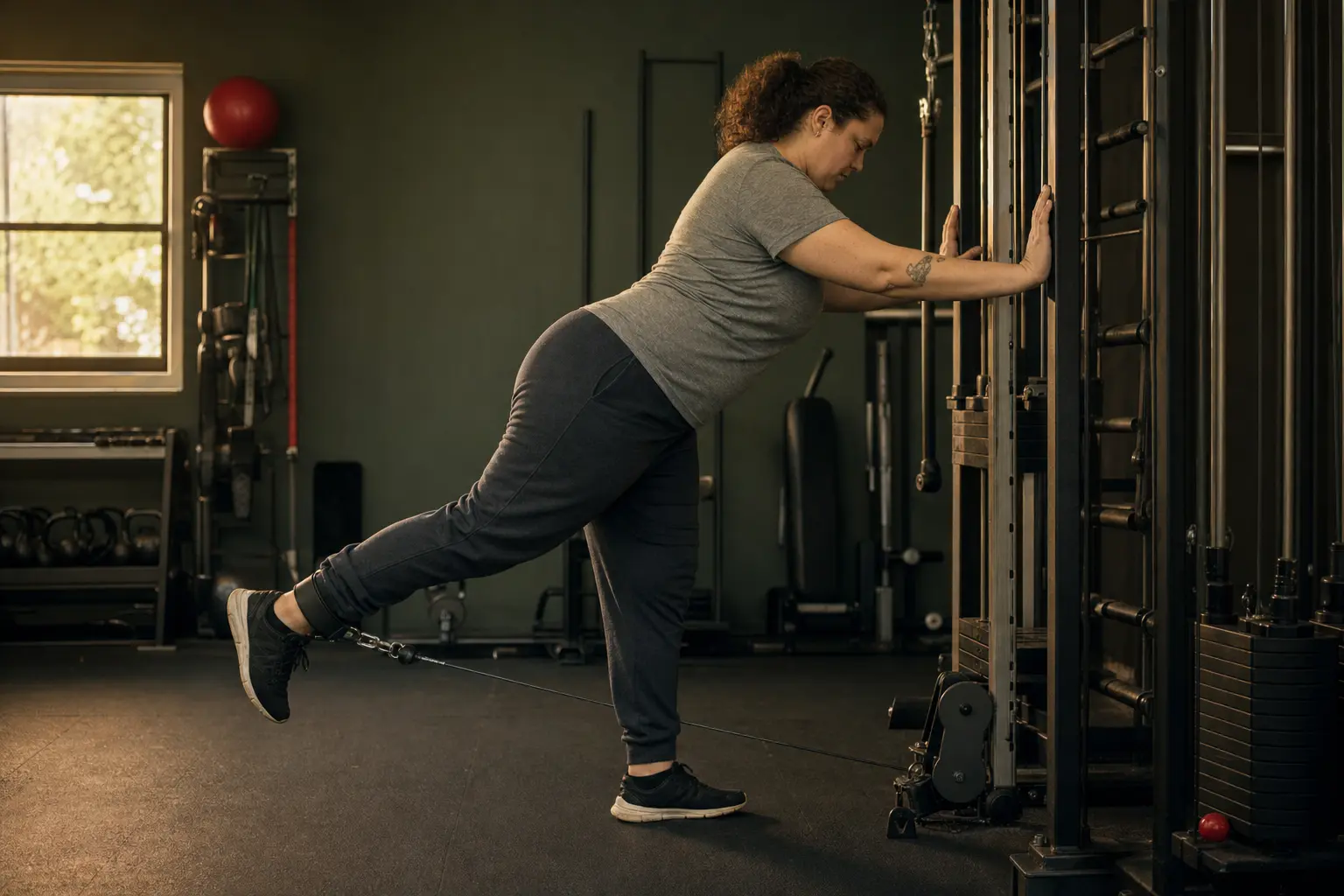
To do glute kickbacks on a cable, clip an ankle strap to a low pulley and face the machine, holding on for balance. Lean forward a little, then push one leg straight back by squeezing your glute, without arching your lower back. Bring it back slowly and do the same reps on both sides. With no cable, a glute kickback machine or a loop band does the same job.
- Set the cable. Move the pulley to its lowest point and clip on an ankle strap. Fasten the strap around one ankle and pick a light weight.
- Take your stance. Face the machine and hold the frame with both hands. Step back until the cable is tight, then lean forward a little from the hips.
- Brace. Put a soft bend in your standing knee. Tighten your core so your lower back stays still.
- Kick back. Push the strapped leg straight back by squeezing your glute. Stop when your lower back wants to arch.
- Return slowly. Bring your foot back under you with control. Finish your reps, then switch legs.
What glute kickbacks are
A glute kickback moves one leg straight back at the hip against some resistance. Nothing else moves. That makes it a small, simple exercise that trains one side at a time.
Most people do cable kickbacks with an ankle strap. Gyms often have a glute kickback machine as well, and a loop band or plain body weight works at home.
Cable kickback form: a quick check
| Part | What to aim for |
|---|---|
| Pulley and strap | Pulley at the lowest setting, strap snug around your ankle |
| Upper body | A slight forward lean, with both hands on the frame |
| Standing leg | Foot flat, with a soft bend in the knee |
| Working leg | Moves from the hip, with the knee nearly straight |
| Range | Short. Stop when your lower back starts to arch or your hips start to turn |
| Speed | Slow both ways, with no swing |
The range is smaller than it looks in most gyms. Your hip only goes a little way behind your body. Any extra height comes from your lower back, not your glutes.
What muscles do glute kickbacks work?
Kickbacks mostly work the gluteus maximus, the largest of the glute muscles. Your hamstrings help.
A 2021 study compared a standing machine kickback with a one-leg leg press in 15 trained men. Each lift was loaded to a weight they could move 6 times. Glute activity was about the same in both lifts, and hamstring activity was higher in the kickback. In that study, a small one-joint move asked about as much of the glutes as a big one.
A 2026 study looked at growth. For 10 weeks, 17 young adults trained twice a week on a cable. One leg did hip extensions, the movement a cable kickback uses. The other leg did hip abductions, lifting out to the side. Each leg did about 10 sets a week of 8 to 12 reps. Scans showed how much the gluteus maximus grew:
| Part of the gluteus maximus | Kickback-style leg | Side-lift leg |
|---|---|---|
| Upper | 5% | 10% |
| Middle | 8% | 4% |
| Lower | 14% | 1% |
| Whole muscle | 9% | 5% |
Hip extension strength on the kickback-style leg rose by 40%. This was one small study, and results differ from person to person. Still, it suggests that kickbacks and side lifts cover different parts of the same muscle. For side lifts, see the hip abduction machine and gluteus medius exercises.
Kickback variations
| Version | How to do it | Good to know |
|---|---|---|
| Cable kickbacks | Standing, with an ankle strap on a low pulley | Smooth resistance in small steps |
| Glute kickback machine | Standing or kneeling against a pad, pushing a foot plate back | Holds you steady, with no strap to fit |
| Banded kickbacks | A loop band around both ankles | Gets harder as the band stretches |
| Standing kickbacks | No equipment, hands on a wall or chair | A good way to learn the move |
| Kickbacks on hands and knees | Knee bent, pushing the sole of your foot toward the ceiling | No equipment. Add a band or an ankle weight later |
A study of 20 healthy adults tested kickbacks on hands and knees, with the knee bent and with the knee straightening. In both, the gluteus medius and the upper gluteus maximus worked harder than the small muscle at the front of the hip.
Sets and reps
Start with 2 or 3 sets of 8 to 12 reps on each leg, two days a week. That is close to what the 2026 growth study used, and it fits the American College of Sports Medicine (ACSM) advice of at least two sets per exercise and at least two sessions a week.
The ACSM’s 2009 guide suggests doing lifts that use several joints before lifts that use one. So put kickbacks near the end, after lifts such as the hip thrust or the Romanian deadlift.
When you can do one or two reps more than your target, add weight. The 2009 guide suggests 2 to 10%. On a cable stack that is often the smallest step up. See progressive overload for other ways to make a set harder, such as more reps or a slower lowering.
Common mistakes, and fixes
| Mistake | Try |
|---|---|
| You swing the leg | Take weight off and pause for a moment at the back of each rep |
| Your lower back arches | Kick lower and brace your core before every rep |
| Your hips turn open | Keep both hip bones facing the machine |
| You wobble on the standing leg | Hold the frame with both hands, or use the kickback machine |
| One side is weaker | Start with that side and match its reps on the other |
Cable kickback alternatives
When the cable is busy, these train the same job of straightening the hip.
- Hip thrust. Both legs at once, with far more load.
- Glute bridge. The floor version. Try it on one leg.
- Back extension. A hip hinge on a 45 degree bench.
- Step-ups. A 2020 review found that step-ups showed the highest glute activity of the loaded exercises it covered. The dumbbell leg workout shows how to do them.
For more, see the best glute exercises. To fit kickbacks into a week, see a good glute workout.
What to expect
Kickbacks train the muscle. They can’t choose where your body stores fat, and no exercise can. Shape comes from your bone structure and from how much muscle and body fat you carry. Train hard and add a little over time. Eat enough protein and enough food to grow muscle. The protein calculator gives you a daily number, and how long it takes to see results covers the wait.
Safety
Check that the ankle strap is fastened and the pin is fully in the stack. Hold on with both hands and move slowly. Stop if you feel sharp pain in your back or hips, and see a doctor or physical therapist if it keeps happening.
Also asked
What muscles do glute kickbacks work?
Mostly the gluteus maximus, with help from your hamstrings. In a study of 15 trained men, glute activity in a machine kickback was about the same as in a one-leg leg press. Hamstring activity was higher in the kickback.
Do cable kickbacks build your glutes?
They can. In a 10-week study, 17 young adults trained one leg with cable hip extensions, the movement a cable kickback uses. The gluteus maximus on that side grew about 9% on average. Results differ from person to person.
Are cable kickbacks or the glute kickback machine better?
They train the same movement, and we found no study that compares them. The cable needs an ankle strap and some balance. The machine holds you in place, so it's easier to learn. Use the one you can do slowly and without swinging.
How do you do banded kickbacks?
Put a loop band around both ankles and hold a wall or a chair. Keep one foot planted and push the other leg straight back against the band. Bring it back slowly. The band pulls harder the farther it stretches, so the end of each rep is the hard part.
Can you do glute kickbacks at home?
Yes. Do standing kickbacks with your hands on a wall, or kneel on your hands and knees and push one foot toward the ceiling. A loop band adds resistance to both.
How much weight should I use for cable kickbacks?
Less than you think. Start with the lightest plates on the stack and find a weight you can move slowly for 8 to 12 reps on each leg. If you have to swing or lean to finish a rep, it's too heavy.
Why do I feel kickbacks in my lower back?
You are likely kicking higher than your hip can go, so your lower back arches to make up the distance. Use a shorter range and a lighter weight. Stop the leg when your lower back starts to move.
Do kickbacks work the gluteus medius?
Not much. In a 10-week study, kickback-style training grew the gluteus maximus and made no clear change in the gluteus medius. Side lifts such as hip abduction are the better pick for that muscle.
What is a good cable kickback alternative?
Any lift that straightens your hip against resistance. Hip thrusts, glute bridges, back extensions and step-ups all do it, and most let you use more weight.
Sources
- Attarieh et al. (2026), Regional Hypertrophy of the Gluteal Muscles Is Task-Specific: Differential Responses to 10 Weeks of Hip Extension Versus Hip Abduction Training
- Stien et al. (2021), Electromyographic Comparison of Five Lower-Limb Muscles between Single- and Multi-Joint Exercises among Trained Men
- Selkowitz et al. (2013), Which exercises target the gluteal muscles while minimizing activation of the tensor fascia lata? Electromyographic assessment using fine-wire electrodes
- Neto et al. (2020), Gluteus Maximus Activation during Common Strength and Hypertrophy Exercises: A Systematic Review
- Currier et al. (2026), American College of Sports Medicine position stand: Resistance training prescription for muscle function, hypertrophy, and physical performance in healthy adults
- American College of Sports Medicine (2009), Progression models in resistance training for healthy adults